Steel and BBS Basics: Cutting Length, Hooks and Bends
Lesson 15 of 60 · 7 min read
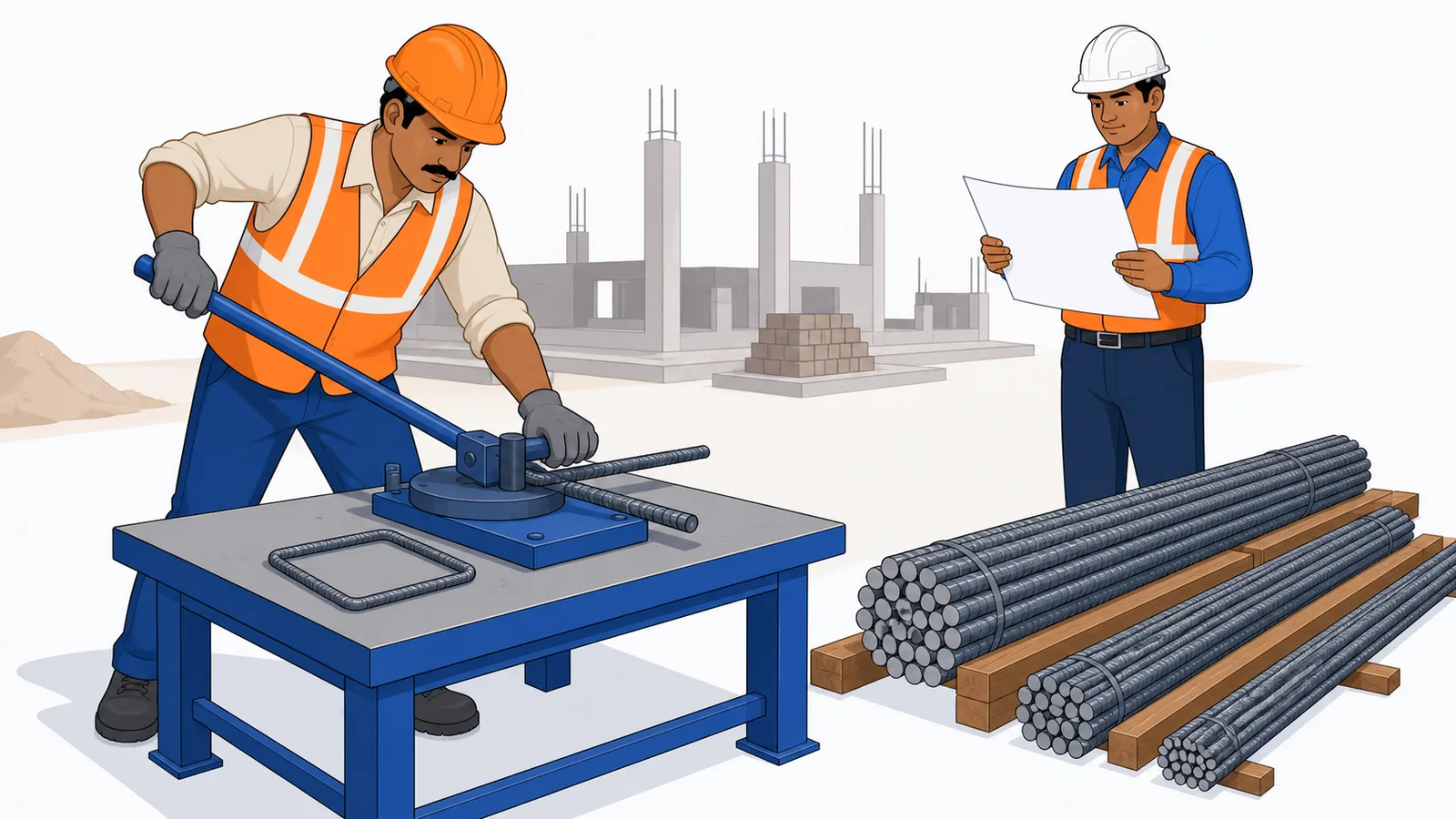
At indicative mid-2026 rates of Rs. 52–64 per kg (city and brand dependent — always check current quotations), reinforcement steel is the most expensive material that enters a residential site by weight. One floor of a small house carries about 1.4 tonnes — Rs. 80,000 or more — in a form that is easy to cut wrong, easy to over-order, and historically easy to pilfer. The bar bending schedule (BBS) is the document that controls all three, and it stands on a handful of numbers this lesson derives from first principles.
The unit weight formula: where d²/162 comes from
Steel weighs 7,850 kg/m³. A bar of diameter d (in mm) and length 1 m has volume (π/4) × (d/1000)² × 1 m³. So:
Weight per metre = (π/4) × d² × 10⁻⁶ × 7850 = 0.006165 × d² = d² ÷ 162.2 kg/m
That denominator — usually rounded to 162 — is nothing mystical: it is 4 × 10⁶ ÷ (π × 7850). The rounded formula overstates weight by only ~0.1 percent, which is why IS 1786's nominal mass table matches it:
| Dia (mm) | kg/m (d²/162) | kg per 12 m bar |
|---|---|---|
| 8 | 0.395 | 4.74 |
| 10 | 0.617 | 7.40 |
| 12 | 0.888 | 10.66 |
| 16 | 1.580 | 18.96 |
| 20 | 2.469 | 29.63 |
| 25 | 3.858 | 46.30 |
TMT bars come in 12 m standard lengths. Memorise the 12 m column — it lets you audit a steel truck in your head: 100 bars of 12 mm should weigh close to 1,066 kg.
Cutting length: the one equation of every BBS
A bar bent to shape uses less steel than the sum of its outer dimensions, because the bend corners are curves, not right angles. Every BBS line is:
Cutting length = sum of outer dimensions + hook allowances − bend deductions
Hook allowances (IS 2502 / SP 34)
The traditional semicircular U-hook (180°) on a mild-steel bar adds 9d per hook — that value comes from IS 2502's hook geometry (bend radius 2d plus a 4d straight tail; the code tabulates 9d, 11d, 13d for larger bend radii k = 2, 3, 4, with a 75 mm minimum). Two conventions to be clear about:
- 9d per U-hook remains the near-universal BBS convention in India even for TMT bars, though strictly the code's larger-radius values apply to higher-strength steel.
- Modern detailing of deformed (TMT) bars mostly avoids end hooks entirely — straight development length or 90° bends are used instead. Use hooks only where the drawing shows them.
Bend deductions
Standard BBS convention (aligned with IS 2502 geometry):
| Bend angle | Deduction |
|---|---|
| 45° | 1d |
| 90° | 2d |
| 135° | 3d |
Where site convention differs — say so in your notes: many contractors deduct a flat 2d for every bend regardless of angle, and some small sites deduct nothing at all, which silently inflates steel weight by 1–2 percent. On a 10-tonne building that is 100–200 kg — Rs. 6,000–12,000 — of phantom steel. Agree the deduction convention with the contractor before the first BBS is priced, in writing.
Stirrup hooks: 135° and 10d
Seismic detailing (IS 13920) requires stirrup/hoop ends to be 135° hooks with a 10d extension, minimum 75 mm, anchored into the concrete core — 90° hooks open up in an earthquake. (The 2016 revision permits 6d, minimum 65 mm, for beam stirrups specifically, but 10d remains the common site and drawing convention; follow your structural drawing.) A 90°-hooked stirrup on a drawing that says 135° is a quality failure you can see from floor level — and in the RERA era, a photographed, dated defect note is how quality obligations get enforced.
Worked example 1: stirrup cutting length
Beam 230 × 450, cover 25 mm, stirrup dia 8 mm. Outer stirrup dimensions: a = 230 − 2 × 25 = 180 mm, b = 450 − 2 × 25 = 400 mm.
| Step | Calculation | Value |
|---|---|---|
| Perimeter | 2 × (180 + 400) | 1,160 mm |
| Two 135° hooks | 2 × 10d = 2 × 80 | +160 mm |
| Bend deductions: 3 × 90° | 3 × 2d = 3 × 16 | −48 mm |
| Bend deductions: 2 × 135° | 2 × 3d = 2 × 24 | −48 mm |
| Cutting length | 1,224 mm |
Weight = 1.224 × 0.395 = 0.483 kg per stirrup. A floor with 400 stirrups = 193 kg ≈ Rs. 11,200 at Rs. 58/kg. Cut them 100 mm too long ("safe side, sahab") and you have donated 400 × 0.1 × 0.395 ≈ 16 kg — about Rs. 900 — per floor to the scrap pile, on one bar mark alone.
Worked example 2: hooked bar
A 10 mm mild-steel link bar, straight length 3.00 m, U-hooks both ends: CL = 3,000 + 2 × 9 × 10 = 3,180 mm; weight = 3.18 × 0.617 = 1.96 kg.
Lap lengths: the code, and where sites differ
Bars come 12 m long; members do not. Where bars join by overlapping, IS 456 (clause 26.2.5.1) requires:
- Flexural tension: lap = development length Ld or 30d, whichever is greater.
- Direct tension: 2Ld or 30d, whichever is greater.
- Compression: lap = Ld in compression, not less than 24d.
- The straight portion of any lap ≥ 15d or 200 mm; laps should be staggered (centres ≥ 1.3 × lap length), and bars above 36 mm are not lapped but welded/coupled.
Computed from the IS 456 bond-stress formula for deformed Fe 500 bars, Ld in tension works out to roughly 57d in M20, 49d in M25, 45d in M30. That is why the universal site convention of "50d lap" is fine with M25 and above but short of code for Fe 500 in M20 — a genuinely useful thing to check on your drawing rather than assume. Site practice also often uses 45d in columns; the structural drawing always governs.
Rupee reality: every lap in a 16 mm bar at 50d consumes 0.8 m = 1.26 kg ≈ Rs. 73. A thekedar paid by the kilogram of fixed steel has an incentive to add unnecessary laps from offcuts; a BBS that pre-plans bar cutting from 12 m stock is your defence — that is Lesson 5.
Buying steel: tolerance and the weighbridge
IS 1786 permits a tolerance on nominal mass (roughly ±7 percent for 8–10 mm bars, ±5 percent for 12 mm and above — check the current table for exact batch vs individual values). The common trap is section-weight billing: the dealer bills bars at nominal weight (count × length × d²/162) while the delivered bars sit legally at the light end of the tolerance — you pay for nominal kilograms and receive fewer actual kilograms of steel. Protect yourself: weigh a sample bundle at the weighbridge and compare against count × 12 m × d²/162. On a 2-tonne order, a 4 percent short-mass is 80 kg — about Rs. 4,600 — per order, invisible without the check. Also note primary-producer brands carry a Rs. 3–6/kg premium over secondary rolling mills; seismic zones and better sites specify Fe 500D (higher ductility) — match the invoice grade to the drawing grade.
Common mistakes
- Using d²/162 with d in inches or metres — the formula needs mm (dimensional consistency is why the 162 exists).
- Adding hook allowances to TMT bars whose drawing shows straight ends.
- Forgetting bend deductions entirely, or deducting hooks instead of adding them.
- Taking 50d laps as gospel when the drawing (or M20 concrete with Fe 500) demands more.
- Ordering total BBS weight without wastage — add 3–5 percent cutting wastage and ~10 kg of binding wire per tonne (common conventions; reconcile at the end).
What comes next
You can now weigh any single bar from its shape. Lesson 5 assembles bars into complete schedules — a full slab and a full beam, marked, counted, weighed and priced.
Key takeaways
- Unit weight = d²/162 kg/m with d in mm — derived from (π/4)d² × 7850 kg/m³, matching the IS 1786 nominal mass table.
- Cutting length = outer dimensions + hook allowances (9d per U-hook) − bend deductions (1d/2d/3d for 45°/90°/135°).
- Stirrups need 135° hooks with 10d (min 75 mm) extensions per IS 13920 — reject 90° hooks on site.
- IS 456 laps: tension = Ld or 30d (Ld ≈ 57d for Fe 500 in M20, 49d in M25); the 50d site rule is not always conservative.
- Agree the bend-deduction convention in writing before pricing — a no-deduction BBS inflates steel 1–2 percent.
- Weigh sample bundles and cross-check metres × d²/162 against billed tonnes; IS 1786 mass tolerance makes light bars legal.
Verify on site
- Verify bar grade (Fe 500/Fe 500D) on the test certificate matches the drawing before unloading.
- Weigh one bundle per truck and compare with d²/162 × total metres.
- Check stirrup hooks are 135° with at least 10d extension before concreting.
- Confirm lap lengths and lap positions against the drawing, not the 50d habit.
- Record steel received, issued and scrap in a register for month-end reconciliation.
- Store bars off the ground on sleepers — rusted, pitted steel triggers rejection and re-billing disputes.
Check your understanding
5 questions. Answering them marks this lesson complete — results stay on your device.
Want the free certificate?
The whole course is free and open — no signup needed to learn. Enter your details only if you want us to track your progress on this device and issue a named certificate after the final assessment.