Brickwork and Blockwork Quantities
Lesson 14 of 60 · 6 min read
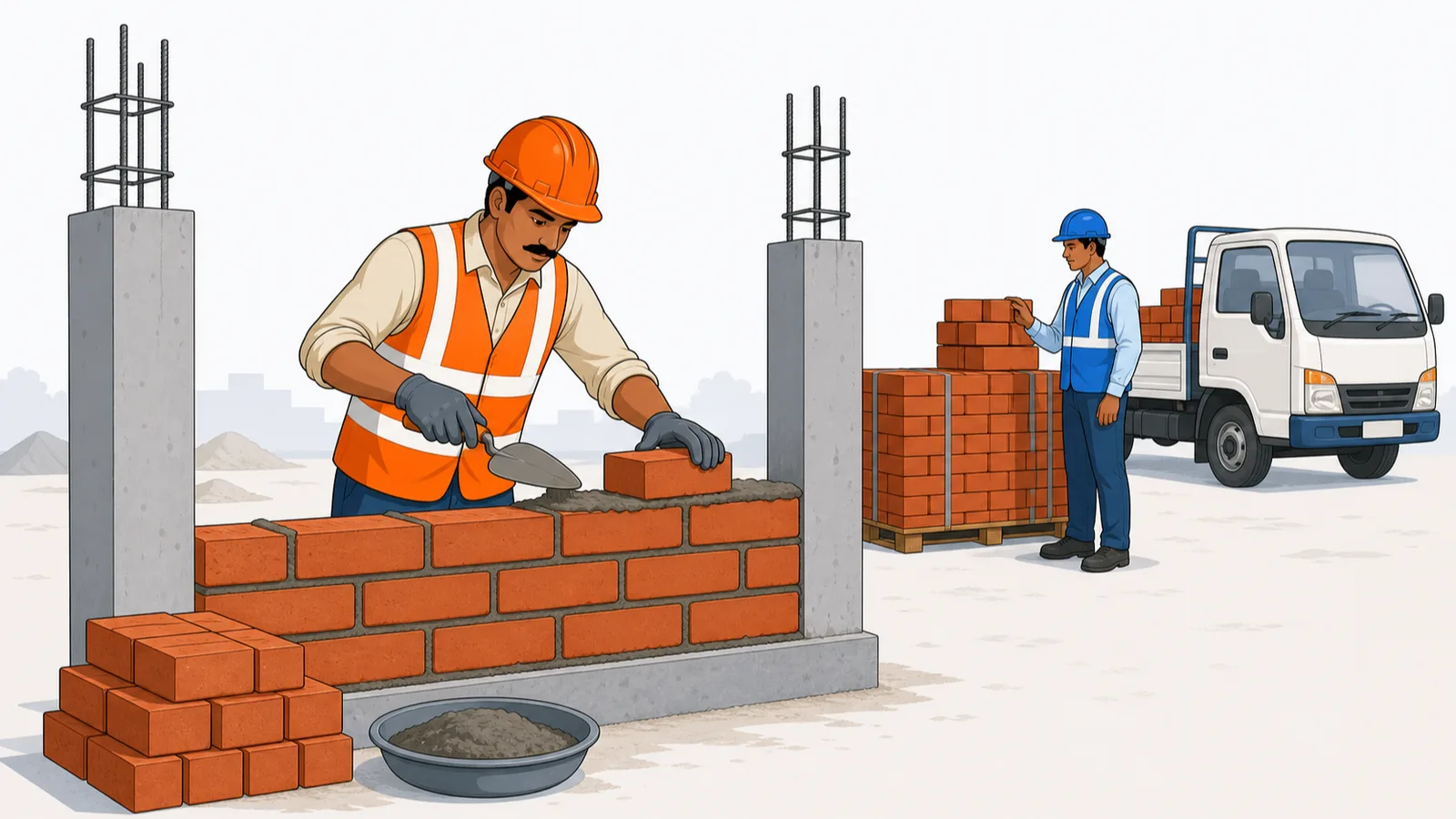
A truck backs into site and the driver says "5,000 bricks". Nobody counts. The thekedar builds, bills per thousand bricks, and at the end of the month the owner is paying for bricks that never existed and walls that were never deducted for windows. Masonry is the item where small unit tricks compound quietly — and it is also the easiest item to defend with twenty minutes of arithmetic.
How masonry is measured
From IS 1200 (Part 3), the rules that matter daily:
- Walls of one brick thickness and above (the 230 mm / 9-inch wall) are measured in m³.
- Half-brick walls (115 mm / 4.5-inch partitions) are measured in m², with thickness stated in the item description. On site you will hear both "sqm" and "sqft" for these — the BOQ should be in m².
- No deduction for openings up to 0.1 m² each; larger openings are deducted. Small bearings and ends of dissimilar members below the code's thresholds are also ignored — check IS 1200 Part 3 for the exact list.
- Brickwork is measured separately by stage (foundation and plinth vs superstructure) and by wall thickness, because rates differ.
In an RCC-framed building the masonry is infill: measure wall lengths clear between column faces, and heights from slab top to beam soffit — the frame was already counted in Lessons 1 and 2.
Brick counts: derive, never assume
The famous "500 bricks per m³" is true for exactly one brick: the modular brick 190 × 90 × 90 mm, which with a 10 mm mortar joint occupies 200 × 100 × 100 mm = 0.002 m³:
Bricks per m³ = 1 ÷ 0.002 = 500
But large parts of North and Central India still use field bricks of about 230 × 110 × 75 mm (the traditional 9 × 4.5 × 3 inch). With 10 mm joints each occupies 240 × 120 × 85 mm = 0.002448 m³:
Bricks per m³ = 1 ÷ 0.002448 = 409
That is an 18 percent difference in count for the same wall volume. Regional brick sizes vary brick to brick and kiln to kiln — measure ten bricks from your actual supply, average the size, and derive your own count. This single habit settles most brick-bill arguments.
Mortar and cement
For 1 m³ of brickwork with 10 mm joints, the wet mortar volume is what is left after the bricks: with modular bricks, 1 − (500 × 0.19 × 0.09 × 0.09) = 1 − 0.77 = 0.23 m³ wet, which becomes roughly 0.30 m³ of dry material after the standard 1.33 dry-volume factor (site norm: take 0.25–0.30 m³ dry mortar per m³ of brickwork). For 1:6 cement mortar this gives the widely used CPWD-linked coefficient:
- Cement ≈ 63 kg = 1.25 bags per m³ of brickwork
- Sand ≈ 0.26 m³ ≈ 9 cft per m³ of brickwork
Half-brick partitions in practice consume proportionally slightly more mortar and always need richer mortar (commonly 1:4) plus reinforcement bands per the drawing — price them as their own item.
Worked example: one bay of the course floor
External wall in one X-direction bay: clear length 2.62 m between columns, height 2.55 m to beam soffit, 230 mm thick, with one window 1.2 × 1.2 m.
| Step | Calculation | Result |
|---|---|---|
| Gross volume | 2.62 × 2.55 × 0.23 | 1.537 m³ |
| Window deduction (1.44 m² > 0.1 m² → deduct) | 1.2 × 1.2 × 0.23 | 0.331 m³ |
| Net brickwork | 1.537 − 0.331 | 1.21 m³ |
| Bricks (modular) | 1.21 × 500 = 605 + 5% wastage | 635 nos |
| Cement (1:6) | 1.21 × 1.25 bags | 1.5 bags |
| Sand | 1.21 × 0.26 = 0.31 m³ | ≈ 11 cft |
In rupees, at indicative mid-2026 rates (red clay brick Rs. 8–12 each in most metros, cement Rs. 380–430 a bag, sand Rs. 45–85 per cft — always use your city's current quotations): bricks 635 × Rs. 9 ≈ Rs. 5,700, cement ≈ Rs. 600, sand ≈ Rs. 700. Material for this one bay ≈ Rs. 7,000.
Now see what the deduction rule is worth: that one window removed 0.331 m³ ≈ 166 bricks plus mortar — roughly Rs. 1,800 per window. Six windows on a floor is Rs. 10,000+ per floor riding on whether openings were deducted. A thekedar billed per m³ or per thousand bricks has no incentive to deduct them; your measurement sheet is the only thing that does.
Blockwork: the AAC alternative
In metro and developer-led construction (Mumbai, Pune, Bengaluru, Hyderabad high-rises especially), AAC blocks have largely replaced clay bricks — driven by weight (about a third of clay masonry, which matters on RCC frames), speed, and state restrictions on clay kilns; near thermal power plants fly-ash brick use is mandated for many works. The takeoff logic is identical, only the module changes:
- Standard block 600 × 200 × 200 mm = 0.024 m³ → about 41.7 blocks per m³ ignoring joints; with 3 mm thin-bed adhesive joints, plan on ~41 and add 3–5 percent wastage (AAC chips at edges).
- Indicative mid-2026: Rs. 45–55 per 200 mm block, i.e. roughly Rs. 4,000–5,500 per m³ — comparable to or cheaper than clay per m³ once you count mortar and speed. Adhesive consumption comes from the manufacturer's datasheet, not from mortar coefficients.
- Regionally: red brick still dominates small-town North India; M-sand has replaced river sand for mortar across much of the South because of river-sand mining bans and royalty costs. Say which materials your estimate assumes.
How masonry labour is actually bought
Three quoting styles coexist, and the takeoff protects you differently in each. A thekedar item rate (per m³ for 230 walls, per m² for partitions, materials yours) is the cleanest — your measured 1.21 m³ bay is the bill, deductions included. A per-1,000-bricks rate pays for bricks laid, so the mason has no reason to economise mortar joints or respect openings — insist measurement still follows IS 1200, with brick count only as a cross-check. Hiring naka labour (daily-wage mason plus helper; big-city rates commonly run around Rs. 900–1,200 for a mason and Rs. 500–700 for a helper — illustrative, strongly city-dependent) makes output your risk: a fair benchmark is roughly 1–1.25 m³ of 230 brickwork per mason-day with helper, so the takeoff tells you how many mason-days the floor should take before you agree to an open-ended arrangement. Whatever the style, add curing to your plan — brick walls want water twice daily for about 7 days, and in summer a curing lapse shows up later as plaster cracks that someone will bill you to repair.
Common mistakes
- Measuring walls through columns. In a framed building the RCC was already measured; masonry is clear-span infill.
- Forgetting to subtract the beam depth from wall height — walls stop at the beam soffit (2.55 m here, not 3.0 m).
- Assuming 500 bricks/m³ for non-modular bricks — with 230 × 110 × 75 bricks the true count is ~409.
- No opening deductions (or deducting a 0.09 m² niche that the code says to ignore).
- Accepting truck counts. A typical truck carries 2,500–4,000 bricks depending on size. Count one stacked layer, multiply by layers, sign the challan with the counted figure.
- Billing half-brick walls in m³ — they are m² items with thickness stated.
What comes next
The frame is measured, the walls are measured. Next comes the material that costs more per kilogram than any other on site — steel — and the document that controls it: the bar bending schedule.
Key takeaways
- One-brick (230 mm) walls are measured in m³; half-brick (115 mm) partitions in m² — and openings above 0.1 m² are deducted (IS 1200 Part 3).
- 500 bricks/m³ holds only for modular 190 × 90 × 90 bricks; a 230 × 110 × 75 field brick gives ~409 — derive the count from your actual brick.
- Per m³ of 1:6 brickwork budget ~1.25 bags of cement and ~9 cft of sand (0.30 m³ dry mortar).
- In a framed building, masonry is infill: clear lengths between columns, heights up to beam soffits.
- Each 1.2 × 1.2 m window deduction is worth roughly Rs. 1,800 of material — deductions are where the money hides.
- AAC (41-42 blocks/m³) dominates metro high-rise work; clay brick and sand types vary by region — state your assumption in the estimate.
Verify on site
- Measure ten bricks from the delivered lot and derive bricks-per-m³ from the average size.
- Count one truck by stack layers before unloading and write the count on the challan.
- Check wall heights stop at beam soffits and lengths run clear between columns.
- Record every opening above 0.1 m² in the measurement book with its deduction.
- Verify mortar mix ratio (1:6 walls, richer for partitions) against the specification.
- Track dealer credit terms — brick and sand rates quoted on credit often carry 3-5 percent over cash rates.
Check your understanding
5 questions. Answering them marks this lesson complete — results stay on your device.
Want the free certificate?
The whole course is free and open — no signup needed to learn. Enter your details only if you want us to track your progress on this device and issue a named certificate after the final assessment.