Plaster, Putty and Paint Quantities
Lesson 17 of 60 · 6 min read
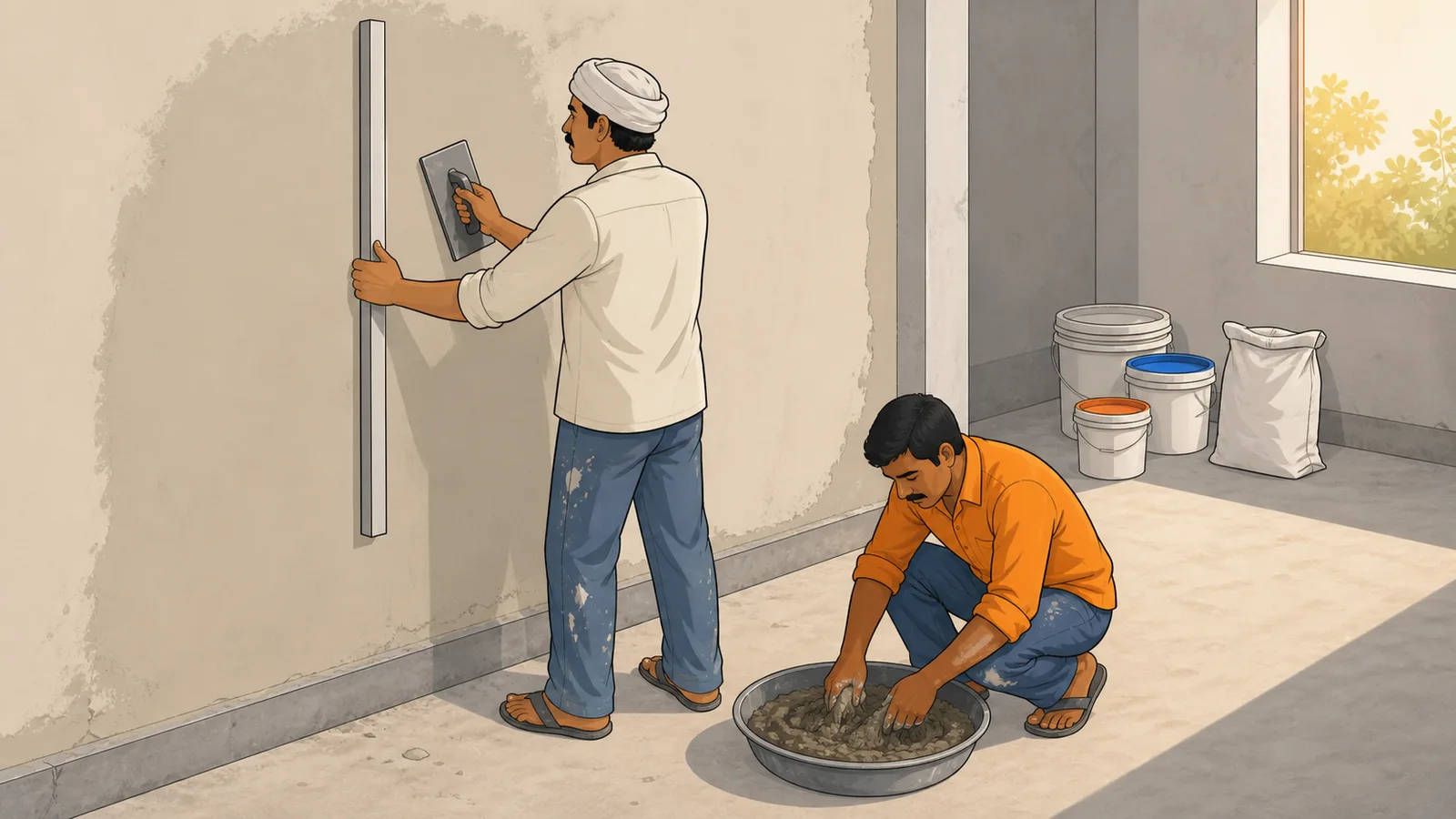
Plaster and paint are where the billing unit changes hands: your BOQ says m², the plaster thekedar quotes per sqft, the painter quotes per sqft "putty-primer-do-coat", and the paint dealer sells litres against a brochure coverage number achieved once, in a lab, on a perfectly smooth board. Every handover between those units leaks money. The fix is the same as always: measure once, correctly, and convert on paper.
Thicknesses, mixes and measurement
Standard practice on Indian residential work (your specification governs):
- Internal walls: 12 mm single-coat, commonly 1:6 cement mortar on brick; smooth or sponge finish.
- Ceilings: 6 mm, richer mix (commonly 1:3 or 1:4) on concrete soffits.
- External walls: 15–20 mm, usually two coats, often with waterproofing compound; chicken mesh over every RCC-masonry junction (measured separately in running metres) to control cracks.
Plaster is measured in m², and IS 1200 (Part 12) gives the three-band opening rule that decides most disputes:
| Opening size (each) | Deduction | Jambs/sills/soffits |
|---|---|---|
| up to 0.5 m² | none | not measured |
| 0.5 to 3 m² | one face only | not measured |
| above 3 m² | both faces | measured and added |
The bands are a deliberate trade: for mid-size openings you "lose" the second face's deduction but do the jamb and sill plaster free; for big openings everything is counted explicitly. When both wall faces carry the same plaster, the single deduction is taken once for the pair (the code assigns it by reveal widths; where reveals are equal, 50 percent each face). Regionally, note that gypsum plaster has widely replaced sand-cement for internal walls in NCR and many metros (no curing, no sand, quoted per sqft with thickness) — same measurement logic, different coefficients.
Material coefficients you can defend
For 12 mm, 1:6 plaster, the CPWD-linked consumption norm is about 7.2 bags of cement per 100 m² with roughly 1.6–1.7 m³ of sand (includes wastage and surface unevenness; site ranges run 7–8 bags). That is ~0.072 bags and ~0.017 m³ sand per m². For finishes, use ranges and say so:
- Wall putty, 2 coats: 0.7–0.8 kg/m² (12–15 sqft per kg)
- Primer: ~10 m² per litre per coat
- Interior emulsion, 2 coats: 6–9 m² per litre total (brochures claim more; bare fresh putty drinks paint)
Worked example: one room, floor to ceiling
Take the course floor's typical room: clear plan 2.62 × 2.77 m, wall height to slab soffit 2.875 m (3.00 minus 125 slab; beams flush over the 230 walls here). One door 0.9 × 2.1 m, one window 1.2 × 1.2 m.
| Step | Calculation | Result |
|---|---|---|
| Wall perimeter | 2 × (2.62 + 2.77) | 10.78 m |
| Gross wall area | 10.78 × 2.875 | 30.99 m² |
| Door 1.89 m² (band 0.5–3 → one face) | −1.89 | |
| Window 1.44 m² (band 0.5–3 → one face) | −1.44 | |
| Net wall plaster (12 mm) | 27.66 m² ≈ 298 sqft | |
| Ceiling plaster (6 mm) | 2.62 × 2.77 | 7.26 m² ≈ 78 sqft |
| Cement (walls, 1:6) | 27.66 × 0.072 | ≈ 2.0 bags |
| Sand (walls) | 27.66 × 0.017 | ≈ 0.47 m³ ≈ 17 cft |
| Putty (walls + ceiling, 2 coats) | 34.92 × 0.75 | ≈ 26 kg |
| Primer | 34.92 ÷ 10 | ≈ 3.5 L |
| Emulsion (2 coats) | 34.92 ÷ 7 | ≈ 5.0 L |
In rupees, with rates clearly labeled as illustrative (take current quotations): cement 2 bags ≈ Rs. 800; sand 17 cft at Rs. 60 ≈ Rs. 1,000; putty 26 kg at Rs. 30/kg ≈ Rs. 780; primer plus emulsion ≈ Rs. 1,800–2,500 mid-brand. Materials ≈ Rs. 4,500–5,000 for one room, before labour.
The dispute angle: gross sqft billing
Most painter and plasterer quotes are per sqft, and the quiet default is gross measurement — no opening deductions. In our room that adds 3.33 m² = 36 sqft to every coat of every face. At an assumed finishing labour rate of Rs. 20/sqft (illustrative), that is about Rs. 720 per room per painting cycle; across eight rooms and repaints, five figures. The IS 1200 bands exist precisely so both sides can agree in advance. Write into the work order: "measurement per IS 1200 Part 12, openings deducted per code bands" — one sentence, and every future bill becomes checkable. Keep the measured sheet with the RA bill; in the RERA era the paper wins.
Two more billing traps worth naming:
- Coverage optimism. A 20 L emulsion pail "covers 2,200 sqft" only on sealed smooth surfaces. On fresh putty over new plaster, plan 65–100 sqft per litre for two coats and buy in two lots — the second lot after the first coat tells you the true consumption.
- Height extras. Many finishing thekedars add a rate premium above 10 ft working height. Legitimate — but only if the wall actually exceeds it; our 2.875 m walls do not reach 10 ft.
External plaster: a different animal
Do not price the outside from inside coefficients. External plaster is 15–20 mm in two coats (a 12–15 mm base and a 6 mm finish, commonly 1:5 or richer with waterproofing compound dosed per the manufacturer), applied off scaffolding, cured harder, and preceded by chicken mesh strips over every column-wall and beam-wall junction. For one bay of the course floor's facade — 3.0 m wide × 3.0 m full floor height = 9.0 m² — expect roughly double the cement of the same internal area, plus mesh in running metres and a scaffolding cost that exists whether the plaster crew works one day or five. This is why external plaster rates per sqft run 1.5–2× internal rates, and why "same rate andar-bahar" (same rate inside and outside) in a quote is a red flag in whichever direction it was averaged.
A regional note on the inside: gypsum plaster (widely used in NCR, Mumbai and other metros) replaces both the 12 mm sand-cement coat and the putty step — one material, no curing, quoted per sqft by thickness. When comparing quotes, compare systems: sand-cement + putty + primer versus gypsum + primer, each with its own coverage arithmetic, not line-item rates across different systems.
Common mistakes
- Deducting openings from both faces when the code band says one.
- Forgetting ceiling plaster and beam sides in framed buildings — soffit plaster is real area (the full-floor ceiling in Lesson 8 is bigger than the plan area because of beam ribs).
- Using internal coefficients for external plaster — thicker, two coats, richer mix, mesh: a different item at a different rate.
- Measuring plaster before the surface exists: openings that will hold full-height frames or shutters flush to wall need no jamb plaster at all — check the door schedule first.
- Paying putty by the bag without an area basis — 26 kg for this room, not "do bori laga di" (two bags used).
What comes next
Openings appeared in every lesson so far — deducted at 0.1 m² in brickwork, 0.4 m² in formwork, banded in plaster. Lesson 7 puts all the opening rules side by side, adds the door/window painting coefficients, and settles the deduction question once and for all.
Key takeaways
- Plaster openings follow three bands: ignore up to 0.5 m², deduct one face from 0.5–3 m² (jambs free), deduct both faces above 3 m² with jambs measured.
- 12 mm 1:6 plaster consumes about 7.2 bags of cement and ~1.7 m³ of sand per 100 m².
- Budget putty at 0.7–0.8 kg/m² and two-coat emulsion at 6–9 m² per litre — not at brochure coverage.
- One typical room: 27.7 m² net wall plaster + 7.3 m² ceiling ≈ Rs. 4,500–5,000 of finishing material.
- Gross-sqft painter billing without deductions costs roughly Rs. 700 per room per cycle — cite IS 1200 Part 12 in the work order.
- External plaster is a separate item: thicker, two coats, mesh at RCC junctions, different rate.
Verify on site
- Check plaster thickness with a screed strip or nail test at random spots before it sets.
- Record every opening with its band (below 0.5, 0.5–3, above 3 m²) in the measurement sheet.
- Verify mortar mix proportions at the mixing platform, not from the bill.
- Confirm chicken mesh runs over all RCC-masonry junctions before internal plaster.
- Measure putty and paint consumption per room against area-based norms, not bags and pails used.
- Photograph finished, measured surfaces before handover to the next trade.
Check your understanding
5 questions. Answering them marks this lesson complete — results stay on your device.
Want the free certificate?
The whole course is free and open — no signup needed to learn. Enter your details only if you want us to track your progress on this device and issue a named certificate after the final assessment.