Anti-Termite Treatment and DPC Quantities
Lesson 10 of 60 · 7 min read
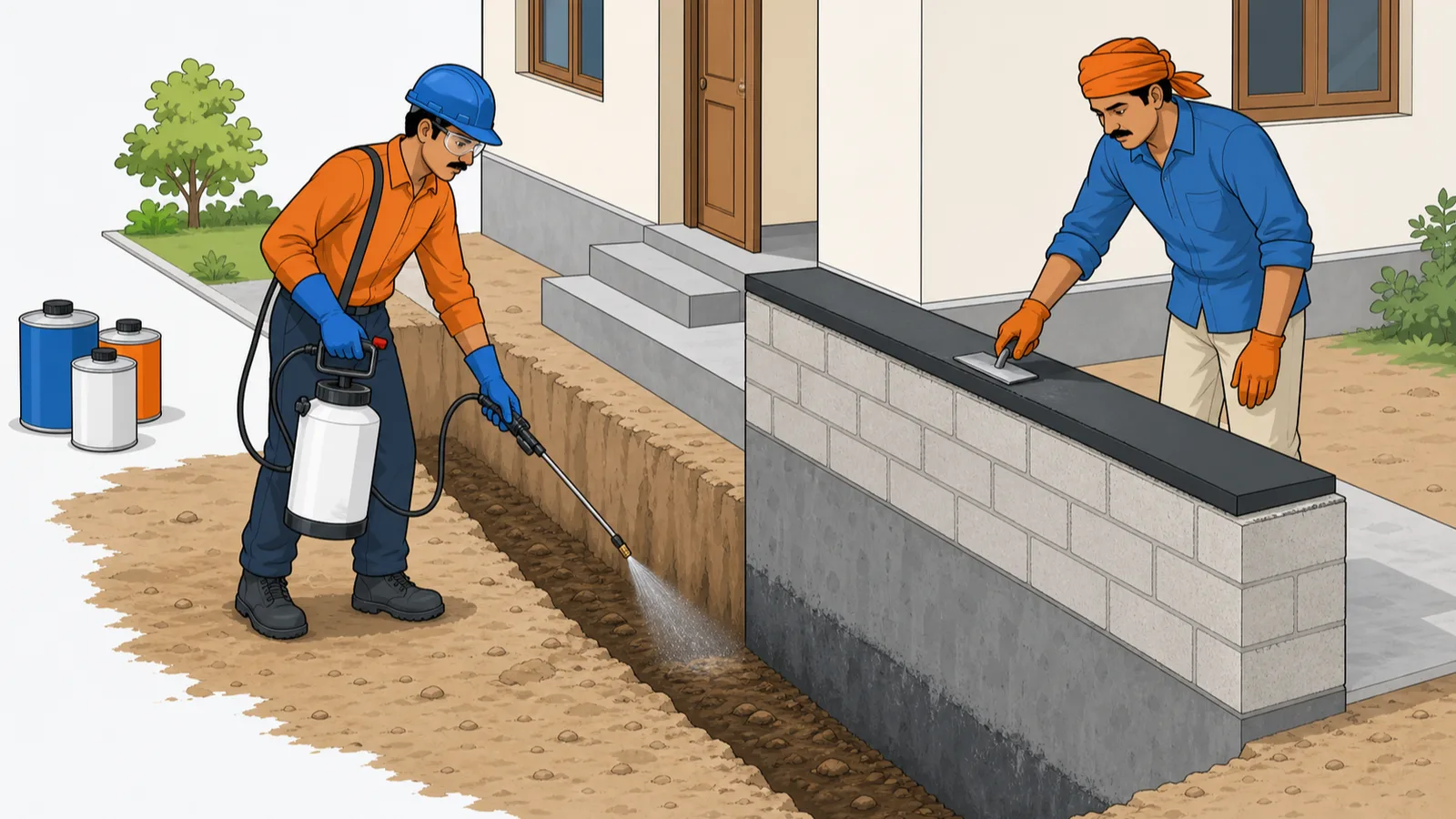
A pest-control agency quotes ₹6 per square foot for "complete anti-termite treatment with 10-year guarantee" on a small house. Sounds like a bargain — until you compute what the Indian Standard actually asks them to pour into the ground. For the building in this lesson, code-dosage treatment needs about 1,400 litres of chemical emulsion. At that quote, the agency collects about ₹5,200 for the whole job; the chemical alone, dosed to code, costs several times that. Something has to give, and it is always the litres. The same logic applies to the 40 mm damp-proof course a mason wants to skip "because the plinth is high anyway". Both layers are invisible within weeks and irreplaceable forever — which is exactly why a QS must be able to compute them, not just nod at a lump-sum quote.
Anti-termite treatment: a chemical barrier, built in stages
Pre-constructional chemical treatment under IS 6313 (Part 2) builds a continuous poisoned-soil barrier under and around the building. The commonly specified chemical is chlorpyrifos 20 EC diluted to a 1.0 percent emulsion (1 part concentrate to 19 parts water); imidacloprid-based emulsions at much lower concentrations are a newer alternative — confirm the currently permitted chemical and concentration with your specifier, since several older chemicals are banned. What matters for takeoff is the application rate per stage:
| Stage | Surface | Rate |
|---|---|---|
| 1 | Bottom of foundation trenches and pits, plus sides up to 300 mm height | 5 litres/m² |
| 2 | Refill earth in contact with foundation faces, as backfilling proceeds | 7.5 litres/m² of vertical surface |
| 3 | Top surface of consolidated plinth fill, before soling or floor bed | 5 litres/m² |
| 4 | Wall-floor junction strip (rodded and poured before the floor is laid) | 7.5 litres/m² of vertical surface |
| 5 | External perimeter of the finished building, rodded at about 150 mm intervals to 300 mm depth | 7.5 litres/m² of vertical surface |
Treatment is measured and billed per stage — surface area × rate gives emulsion litres; divide by 20 for the concentrate volume at 1 percent dilution from a 20 percent EC.
Worked example: 10 m × 8 m house
Load-bearing house, 10.00 m × 8.00 m out-to-out, 230 mm walls, one full internal cross wall, trench 900 mm wide × 900 mm deep. Centre-line sheet (lesson 1): external CL = 2 × (9.77 + 7.77) = 35.08 m; cross wall 7.77 m; total 42.85 m with 2 T-junctions. Effective lengths: trench (b = 0.90) 41.95 m; plinth wall (b = 0.23) 42.62 m. Inside plinth area = 80.00 − 42.62 × 0.23 = 70.20 m². External perimeter = 2 × (10 + 8) = 36.00 m.
| Stage | Working | Area | Emulsion |
|---|---|---|---|
| 1. Trench bottom | 41.95 × 0.90 = 37.76 m²; sides 2 × 41.95 × 0.30 = 25.17 m² | 62.93 m² | × 5 = 315 L |
| 2. Refill against foundation | both faces: 2 × 41.95 × 0.90 | 75.51 m² | × 7.5 = 566 L |
| 3. Top of plinth fill | inside area | 70.20 m² | × 5 = 351 L |
| 4. Wall-floor junction | inner wall faces about 49.2 m × 0.30 strip | 14.77 m² | × 7.5 = 111 L |
| 5. External perimeter | 36.00 × 0.30 | 10.80 m² | × 7.5 = 81 L |
| Total emulsion | 1,424 L |
Concentrate (1 percent from 20 EC) = 1,424 / 20 = about 72 litres, mixed with roughly 1,350 litres of water. (Stage 4's junction length is estimated from the inner wall faces — 2 × 42.62 minus the 36 m outer perimeter; state your basis on the sheet so it can be checked.)
Now audit that ₹6/sqft quote. Plinth area = 80 m² = 861 sqft, so the job price is about ₹5,200. At indicative mid-2026 prices of roughly ₹300 to ₹450 per litre for branded chlorpyrifos 20 EC (always check current dealer quotations), the 72 litres of concentrate alone cost ₹22,000 to ₹32,000. A ₹5,200 lump sum therefore cannot be delivering code dosage — the agency is either treating one or two stages only, diluting far beyond 1 percent, or both. That does not automatically make the quote fraudulent; plenty of owners knowingly buy a perimeter-only treatment. It makes it your job to know which stages are in the price. Get the stage list, the chemical, the dilution and the litres per stage written into the work order, and take delivery of sealed concentrate cans on site — the guarantee certificate (commonly 10 years, on stamp paper) is worth exactly as much as the litres that went into the soil.
Regional and safety notes: termite pressure is highest in the warm, humid plains and coastal belts; some rocky or high-altitude sites skip pre-construction treatment by local practice — a decision to record in writing, not drift into. Treatment must not happen when the soil is wet with rain, and treated sites must keep the chemical away from wells and borewells; the emulsion is genuinely poisonous, so insist on gloves, boots and no smoking during application.
DPC: the 40 mm layer against rising damp
The damp-proof course stops ground moisture climbing the plinth masonry into your walls — the source of the peeling paint and white salt patches (efflorescence) that appear two monsoons after possession. Standard residential practice: a 40 mm thick layer of cement concrete 1:2:4 laid over the full width of every plinth wall at plinth level, with an integral waterproofing compound dosed at about 1 kg per 50 kg bag of cement (per the manufacturer's datasheet), finished dense and cured. Richer mixes or membrane DPCs appear in wetter climates and better specifications — regional practice varies.
Measurement is simple and unforgiving: square metres of wall-top area, thickness stated.
- DPC area = effective centre-line length at the wall thickness × wall thickness.
- Deduct door openings (and verandah crossings) where practice omits the DPC at sills — a common convention, though some specifications run it continuous; follow your contract.
For the example house: 42.62 × 0.23 = 9.80 m². Deduct the main door (1.0 m) and three internal doors (3 × 0.9 m): 3.7 m × 0.23 = 0.85 m². Net DPC = 8.95 m² — about 0.36 m³ of concrete, two to three bags of cement and 2 to 3 kg of compound. At an indicative all-in rate of ₹300 to ₹500 per m² (mid-2026), the whole item costs ₹2,700 to ₹4,500. Compare that with the cost of the dispute it prevents: rising damp in a finished house means breaking plaster, injecting chemical DPC and repainting — routinely ₹50,000 upwards, plus an unwinnable argument about whose fault it was. Under the RERA framework, buyers of developer-built homes get a multi-year defect-liability window from possession (five years is the commonly cited period — confirm how your state's rules apply), and damp complaints are among the most frequent claims; a photographed, measured DPC entry in the records is the developer's defence and the buyer's assurance alike.
How this protects your bill in a dispute: both items in this lesson are hidden works. The measurement-book entry, stage-wise litre record with empty-can count, and dated photos before covering are the only evidence that will ever exist. For a self-builder, five photos and one signed page cost nothing; for a contractor, they are what gets the bill certified without a deduction; for a buyer from a developer, they are what a defect claim stands on.
Common mistakes
- Accepting lump-sum anti-termite quotes without a stage list — you cannot audit litres you never specified.
- Treating on rain-soaked soil or letting treated surfaces get rained on before covering — the barrier washes away and no record will save it.
- Forgetting stage 3 (top of plinth fill) because the soling crew arrived early — sequence the trades: fill, consolidate, treat, then soling.
- Measuring DPC in running metres or forgetting it entirely in the BOQ, then discovering the mason skipped it.
- No waterproofing compound in the DPC mix — plain 1:2:4 is porous; the compound and dense finishing are the point.
- No photos before covering — both layers disappear within days.
Where this goes next
You now hold every substructure item this module teaches: earthwork, PCC, footings, masonry, backfill, fill, soling, anti-termite treatment and DPC. The final lesson chains them into one continuous takeoff of a 2BHK house — one centre-line statement feeding every quantity, ending in a summary sheet you could hand to a contractor tomorrow.
Key takeaways
- Anti-termite treatment is computed stage by stage: 5 L/m² on trench bottoms, trench sides to 300 mm and the plinth-fill top; 7.5 L/m² on vertical refill faces, wall-floor junctions and the external perimeter strip.
- Concentrate volume = emulsion litres / 20 for a 1 percent emulsion from chlorpyrifos 20 EC — and code-dosage chemical costs more than many lump-sum quotes charge for the whole job.
- Put the stage list, chemical, dilution and litres into the anti-termite work order; the 10-year guarantee is worth only the litres actually poured.
- DPC is 40 mm of dense CC 1:2:4 with waterproofing compound over the full plinth-wall width, measured in m² with thickness stated.
- Both items are hidden within days — dated photos, litre records and MB entries before covering are the only evidence that will ever exist.
- Termite risk and DPC practice vary regionally; recording a conscious decision beats silently following whatever the thekedar did last time.
Verify on site
- Verify sealed concentrate cans on site and count empties against the stage-wise litre calculation.
- Check soil is not rain-wet before any treatment stage, and cover treated surfaces the same day.
- Sequence stage 3 before soling: fill consolidated, treated, photographed, then covered.
- Confirm rodding at roughly 150 mm intervals along the wall-floor junction and external perimeter stages.
- Enforce gloves and boots for the spraying crew and keep chemical away from wells and borewells.
- Check DPC concrete is laid in one continuous operation per wall run, dense-finished, with compound dosed per datasheet.
- Cure the DPC and photograph every wall top before the superstructure masonry starts.
- File the guarantee certificate, litre record and photos with the measurement book.
Check your understanding
5 questions. Answering them marks this lesson complete — results stay on your device.
Want the free certificate?
The whole course is free and open — no signup needed to learn. Enter your details only if you want us to track your progress on this device and issue a named certificate after the final assessment.