Per-Sq-Ft Thumb Rules: Useful, and Where They Lie
Lesson 27 of 60 · 8 min read
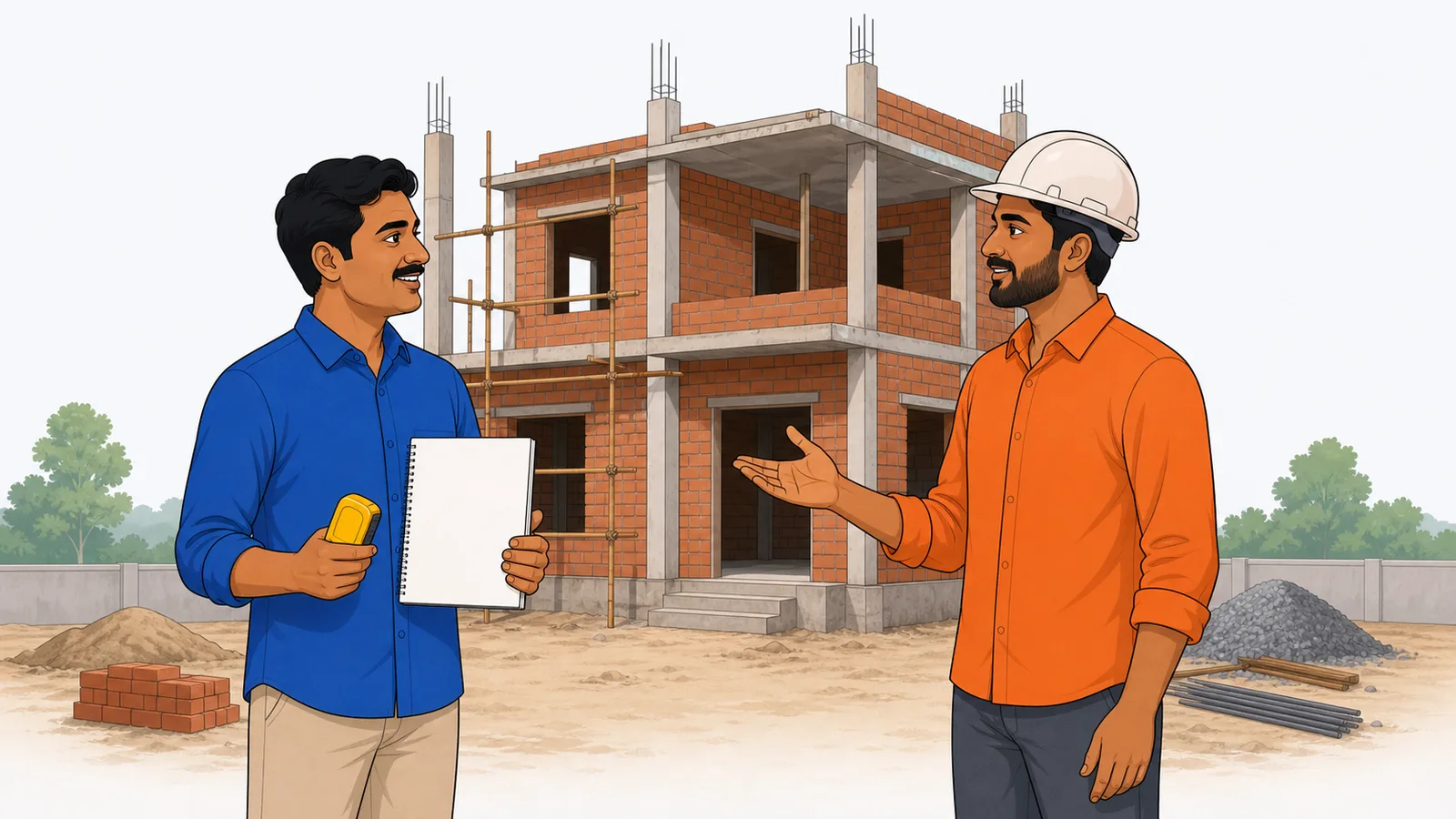
Ask three thekedars what it costs to build a house and you will get three confident answers: "₹1,950 a square foot, sir." "₹2,100, full quality." "₹2,350, but I use only branded material." All three are quoting the same building. None of them has seen a drawing. This is the per-sq-ft thumb rule at work — the most quoted number in Indian residential construction, and the one that sinks more owner budgets than any other, not because it is wrong, but because people use it for jobs it was never designed to do.
What a thumb rule is actually for
A per-sq-ft rate is a preliminary estimating tool. It compresses thousands of BOQ items into one number so you can answer early questions fast:
- Feasibility: "Can I build 1,600 sq ft on this plot with ₹40 lakh, or should I plan 1,200 sq ft?"
- Loan sizing: banks and housing finance companies accept a rate-based rough estimate to fix the sanction amount before detailed drawings exist.
- Sanity check: when a detailed estimate lands on your desk, dividing it by built-up area instantly tells you whether it sits inside the normal band or needs a line-by-line audit.
- Quote screening: a lump-sum quote far below the band usually hides scope cuts; one far above it needs justification, not negotiation.
What a thumb rule is not for: fixing a contract price, ordering material, or certifying a contractor's bill. Those need the detailed quantities you learned to take off in Modules 2 and 3 and the rate analysis from Module 4.
Indicative per-sq-ft bands, mid-2026
These are indicative mid-2026 market ranges for the construction cost of the building itself (structure plus standard services and finishes) in Indian tier-2 and tier-3 locations. Always replace them with current quotations from your own city before deciding anything.
| Finish level | Indicative rate (₹/sq ft of built-up area) | What it typically means |
|---|---|---|
| Basic | 1,600 – 2,000 | Ceramic tile or oxide flooring, standard flush doors, basic CP fittings, exterior cement paint |
| Standard | 2,000 – 2,600 | Vitrified tiles, granite kitchen, branded wiring and sanitaryware, emulsion paints |
| Premium | 2,600 – 3,500+ | Large-format tile or marble, teak or engineered doors, designer bathrooms, false ceilings, elevation features |
Metro construction runs well above these bands — Mumbai and Delhi-NCR quotes of ₹2,500 – 5,000 per sq ft are common because of labour rates, access constraints and compliance costs. The bands also assume a conventional RCC-framed G or G+1 house on ordinary soil; every assumption baked into that sentence is a place the rule can fail, as we will see.
Material thumb rules that go with the rate
Site engineers use companion thumb rules to sanity-check material budgets. Indicative planning figures for conventional RCC residential construction:
| Material | Thumb rule (per sq ft of built-up area) | Notes |
|---|---|---|
| Cement | 0.4 – 0.5 bags | All uses: concrete, masonry, plaster |
| Steel | 3.5 – 4.5 kg | Residential framed structures; commercial runs 5+ |
| Sand | 0.8 – 1.2 cft | Varies with plaster area and masonry type |
| Aggregate | 1.0 – 1.35 cft | Concrete-driven |
These are planning aids, not order quantities — final numbers come only from the structural drawings and your own takeoff. They vary meaningfully with the structural design, number of floors and wall system — a house in an AAC-block region (common across western and southern cities) carries a different masonry and plaster cost profile than one in the north's red-brick belt.
Watch the trade units. Codes and drawings speak SI (m³), but Indian material trade often does not: sand and aggregate are sold per brass (100 cft) across much of western and central India, per tonne or per cft elsewhere. 1 m³ = 35.31 cft, so 1 brass = 2.83 m³. The classic trap: a supplier quoting "₹4,500 per brass" while your estimate is in m³ — mixing the two either triples your sand budget or starves it. Convert once, in writing, before comparing any quote.
Worked example: the 1,600 sq ft duplex
Take the project we will carry through this whole module: a G+1 duplex, 800 sq ft per floor, 1,600 sq ft built-up, standard finish, in a tier-2 city. Three contractors quote ₹1,950, ₹2,100 and ₹2,350 per sq ft with slightly different scopes. We adopt ₹2,100 for planning.
Step 1 — the thumb-rule number.
1,600 sq ft × ₹2,100 = ₹33,60,000
Step 2 — cross-check the two big materials with thumb rules (indicative mid-2026 prices; use your city's current quotations):
| Item | Quantity | Rate | Amount |
|---|---|---|---|
| Cement: 1,600 × 0.45 = 720 bags | 720 bags | ₹400/bag (band 360–430) | ₹2,88,000 |
| Steel: 1,600 × 4.0 = 6,400 kg | 6.4 MT | ₹62/kg (band 55–70) | ₹3,96,800 |
Together ₹6,84,800 — about 20 percent of the ₹33.6 lakh figure, which is the normal share for cement plus steel in a framed house. The thumb rule is internally consistent. So far, so good.
Step 3 — now list what the per-sq-ft rate never included:
| Item outside the rate | Amount |
|---|---|
| Thumb-rule construction cost | ₹33,60,000 |
| External works: compound wall, gate, paving, borewell, sump, septic/sewer connection | ₹2,40,000 |
| Statutory approvals, plan sanction, water and power connections | ₹60,000 |
| Design fees: architect plus structural engineer (about 3%) | ₹1,00,000 |
| Contingency at 5% of the above (Lesson 4) | ₹1,88,000 |
| Escalation provision for a 12-month build (Lesson 4) | ₹1,12,800 |
| Budget you can actually sanction | ₹40,60,800 |
The real number is ₹40.6 lakh — ₹2,538 per sq ft effective, about 21 percent above the quoted thumb rate. Nothing here is padding: every line is a cost the owner will pay. The thumb rule did not lie about construction; it stayed silent about everything else.
Ten ways the sq-ft rate lies
- Scope silence. Compound wall, gate, borewell, rainwater harvesting, approvals — rarely inside anyone's rate, always inside your project.
- Small buildings cost more per sq ft. Mobilization, shuttering sets and minimum labour gangs are fixed costs; on 800 sq ft they spread thin.
- Soil and foundation depth. The rate assumes ordinary soil at 1.5 m. Black cotton soil, filled ground or hard rock rewrite the substructure cost.
- Structural system. A load-bearing house and a framed house with the same area have different steel and concrete appetites.
- Height and voids. Double-height living rooms and large balconies add structure and finish cost without adding "area" the way the rate assumes.
- Finish creep. The band you quoted at "standard" quietly becomes premium tile-by-tile during selection visits.
- Opening percentage. Large glazed openings swap cheap masonry for expensive windows — the rate does not notice.
- Region and access. Hill sites, narrow lanes and material lead distances move labour and cartage significantly. So do regional material realities: river-sand restrictions and aggregate royalty differ state to state, and the brick-belt vs AAC-block divide changes masonry economics.
- Taxes and fees. Whether GST on the works contract is inside the quoted rate is a question you must ask explicitly — treat tax treatment as something to confirm with your CA and contract, not assume.
- Time. A mid-2026 rate is stale by mid-2027. Rates carry a date, always.
How this protects your money in a dispute
The rate argument you will actually have sounds like this: at month eight the thekedar says, "₹2,100 was for structure and plaster only — electrical fittings and compound wall were always extra." If the rate lives in a phone call, you lose. If it lives on one signed page — rate, date, built-up area figure, and a ticked inclusion/exclusion list — the conversation is over before it starts. In the RERA era this documentation habit is no longer optional even for small builders: carpet area now has a precise legal definition for sold property, and area-basis mistakes (quoting on built-up, billing on super built-up) are exactly the kind of ambiguity written records kill. One page, signed before layout marking, is the cheapest insurance in construction.
Common mistakes
- Signing a lump-sum contract on a thumb rate. The rate is for feasibility; contracts need a BOQ with measured quantities and an agreed specification.
- Comparing quotes without comparing scope. ₹1,950 excluding electrical fittings is not cheaper than ₹2,100 including them.
- Using carpet area instead of built-up area. Thumb rates apply to built-up area; carpet area (the RERA-defined net usable area for sold flats) runs 15–25 percent lower, so mixing the two silently mis-sizes the whole budget.
- Quoting a rate without a date and city. "₹2,100" means nothing; "₹2,100, Indore, mid-2026, standard finish" is usable.
Where this goes next
A single number — even a corrected one — cannot be tracked. ₹40.6 lakh only becomes a management tool when you spread it across the stages of construction and ask: how much at foundation, how much at slab, how much at finishing? That stage-wise cost plan is the next lesson.
Key takeaways
- Per-sq-ft rates are for feasibility, loan sizing and quote screening — never for fixing a contract price or ordering material.
- Indicative mid-2026 bands: basic ₹1,600–2,000, standard ₹2,000–2,600, premium ₹2,600–3,500+ per sq ft in tier-2/3 India, always dated and city-specific.
- Companion material thumb rules — 0.4–0.5 cement bags, 3.5–4.5 kg steel, 0.8–1.2 cft sand, 1.0–1.35 cft aggregate per sq ft — sanity-check estimates but never replace a takeoff.
- External works, approvals, design fees, contingency and escalation typically add 15–25 percent above the quoted construction rate.
- A quoted rate is only meaningful with its date, city, finish level and scope attached.
- A signed one-page record of rate, date, area basis and inclusions is what wins the 'that was always extra' argument with a thekedar at month eight.
Verify on site
- Confirm whether each quote's rate includes electrical fittings, sanitaryware, and GST — get the inclusion list in writing.
- Verify the built-up area figure used in the rate calculation against the sanctioned drawing.
- Ask the soil type and assumed foundation depth behind any lump-sum rate.
- Cross-check the quote's implied cement and steel quantities against the 0.4–0.5 bag and 3.5–4.5 kg per sq ft bands.
- List every item outside the rate — compound wall, borewell, approvals, connections — with its own budget line.
- Convert every sand and aggregate quote to one unit before comparing (1 brass = 100 cft = 2.83 m³).
- Date-stamp every rate you record and note the city it came from.
Check your understanding
5 questions. Answering them marks this lesson complete — results stay on your device.
Want the free certificate?
The whole course is free and open — no signup needed to learn. Enter your details only if you want us to track your progress on this device and issue a named certificate after the final assessment.