Cost Breakdown: Material, Labour, Services, Overheads
Lesson 29 of 60 · 7 min read
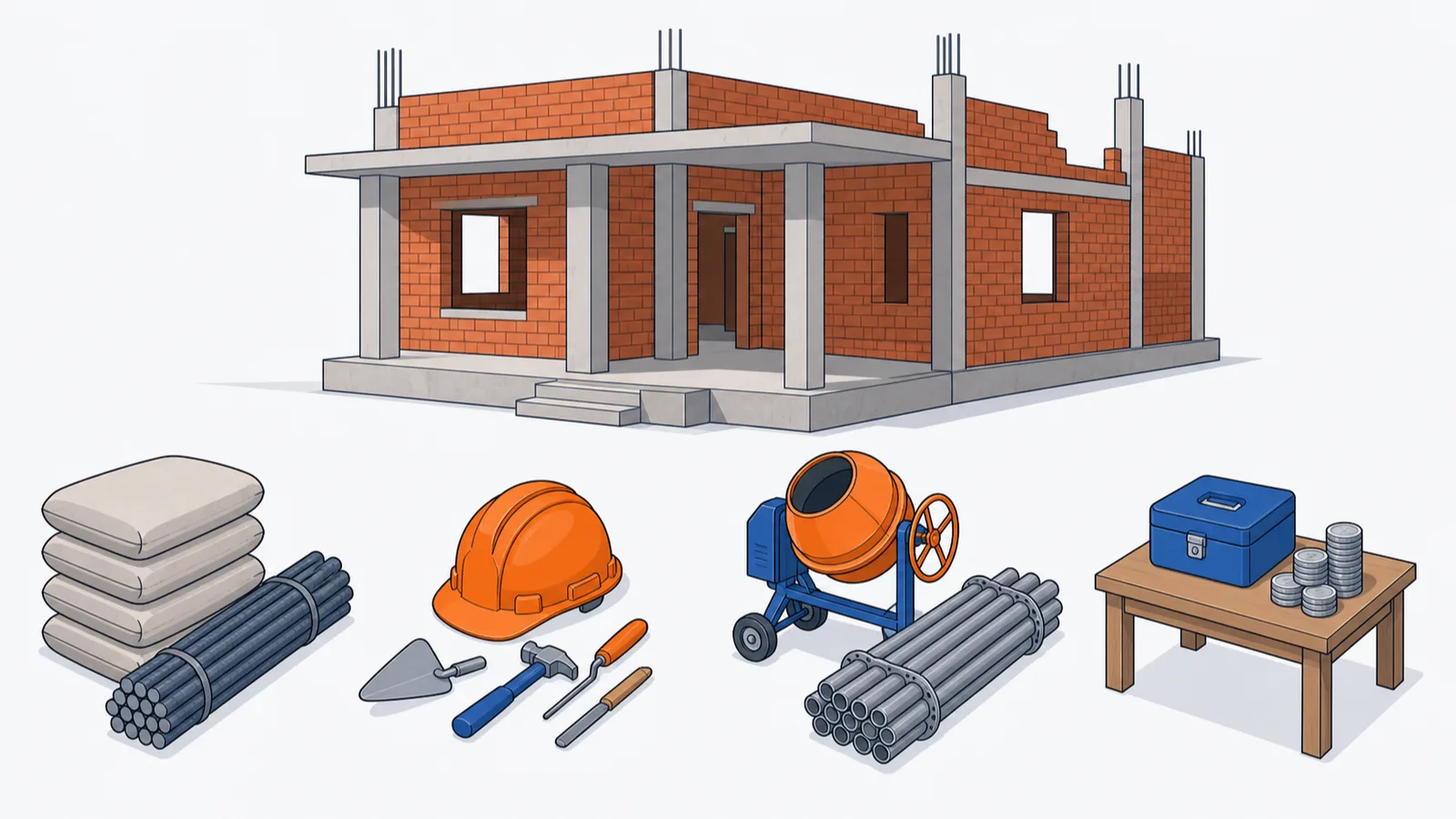
Your stage plan says the RCC frame costs ₹8.06 lakh. Steel prices jump 8 percent next month. How much does your budget move? If you cannot answer within a minute, your budget has only one axis — time — and no resource axis. The cost breakdown structure (CBS) adds that second axis: every rupee classified by what it buys. Material price shocks, labour shortages and a contractor's padded overhead all become visible the day they happen instead of at the final account.
Two ways to slice the same budget
A budget can be decomposed element-wise (what gets built: foundation, frame, finishes — the stage plan from the last lesson) or resource-wise (what gets bought: material, labour, plant, overheads). Professional cost control uses both, because they answer different questions:
- Element-wise answers "which part of the building is over budget?"
- Resource-wise answers "which market movement or party is causing it?"
The CBS is the resource-wise slice. For a conventional residential works contract in India, indicative shares of construction cost are:
| Resource class | Indicative share | What sits inside |
|---|---|---|
| Materials | 55 – 65% | Cement, steel, sand, aggregate, bricks/blocks, tiles, sanitaryware, wiring, pipes, paint, doors, windows |
| Labour | 25 – 35% | Mason gangs, bar benders, carpenters (shuttering), electricians, plumbers, painters, helpers |
| Plant, tools and temporary works | 2 – 5% | Mixer, vibrator, scaffolding, shuttering material amortization, dewatering, lifting |
| Site overheads and supervision | 5 – 10% | Site engineer/supervisor, watchman, site office, power and water for construction, transport, small consumables |
These are indicative for owner-plus-contractor residential work; the split shifts with contract type. In a turnkey contract the contractor's overhead and profit (commonly 10–15 percent embedded across item rates) sits invisibly inside every line; in an owner-managed, labour-contract model the owner buys materials directly and the labour share appears as explicit labour-rate agreements.
Worked example: the duplex budget on the resource axis
Take the ₹33,60,000 construction cost and apply plan shares of 60 / 30 / 3 / 7 (inside the indicative bands, chosen for a standard-finish framed duplex with an owner-managed material supply):
| Resource class | Plan share | Amount |
|---|---|---|
| Materials | 60% | ₹20,16,000 |
| Labour | 30% | ₹10,08,000 |
| Plant and temporary works | 3% | ₹1,00,800 |
| Site overheads and supervision | 7% | ₹2,35,200 |
| Total | 100% | ₹33,60,000 |
Opening the materials basket
The ₹20.16 lakh materials line splits further. Illustrative allocation for this duplex, using indicative mid-2026 prices (always current local quotations before ordering):
| Material group | Basis | Amount |
|---|---|---|
| Cement | 720 bags × ₹400 | ₹2,88,000 |
| Steel | 6,400 kg × ₹62 | ₹3,96,800 |
| Sand and aggregate | takeoff quantities | ₹2,40,000 |
| Bricks / blocks | takeoff quantities | ₹1,80,000 |
| Tiles, sanitaryware, CP fittings | selections | ₹3,20,000 |
| Doors and windows (material) | schedule of openings | ₹2,60,000 |
| Electrical materials | points schedule | ₹1,60,000 |
| Paint and finishing materials | area-based | ₹90,000 |
| Water, consumables, miscellaneous | allowance | ₹81,200 |
| Materials total | ₹20,16,000 |
Now the steel-price question answers itself: steel is ₹3,96,800 of the budget, so an 8 percent rise costs about ₹31,700 if all steel is still unbought — and proportionally less once early consignments are on site. This is the calculation that tells you whether to advance-buy, and it takes one minute precisely because the CBS exists.
The labour line
The ₹10.08 lakh labour share works out to ₹630 per sq ft across all trades. For comparison, composite civil labour-only contracts (owner supplies material) are commonly quoted around ₹250 – 450 per sq ft in mid-2026 depending on region and finish — indicative, with wide regional variation — with specialist trades (electrical, plumbing, painting, carpentry) charged separately, often per point, per fixture or per sq ft of their own work. If a labour quote plus the specialist trades lands far outside your CBS labour line, either the scope differs or someone is padding; the CBS gives you the number to argue from.
Anchor the thekedar's sq-ft quote against naka day rates — what labour actually costs at the morning labour market. Indicative mid-2026 bands: mason ₹600 – 1,000 per day, carpenter/bar bender ₹650 – 1,000, helper ₹300 – 650, with metros running 15 – 25 percent higher and rural areas 20 – 30 percent lower; state minimum wages set the legal floor. A quick sanity check: if a mason-plus-two-helpers gang costs about ₹2,000 a day and lays roughly 1 m³ of brickwork with its plaster prep, you can rebuild any sq-ft labour quote from first principles in ten minutes — which is exactly what to do when a quote smells padded.
Using the CBS as a control tool
- Quote comparison. Two lump-sum quotes can hide entirely different resource splits. Ask each bidder to state material, labour and overhead components; a labour component above roughly 40–45 percent of a full-scope residential quote deserves questions, as does an overhead line above 15 percent.
- Escalation exposure. Escalation applies mostly to unbought materials and future labour. The CBS multiplied by the procurement schedule is your escalation exposure — Lesson 4 uses exactly this.
- Tax visibility. GST treatment differs between a works contract and owner-purchased materials; keeping material and labour lines separate in the budget makes the tax treatment auditable. Frame tax decisions as commonly applied practice to confirm with your CA and contract — not something a thumb split settles.
- Dealer credit is a cost line, not a favour. Material dealers commonly run 30 – 45 day credit cycles for regular buyers, against a cash or advance-payment discount of roughly 1 – 2 percent (commonly seen practice; terms vary by dealer and relationship). On a ₹20 lakh materials basket that spread is worth ₹20,000 – 40,000 — decide deliberately whether you are buying float or buying discount, and record which one each order took.
- Regional material reality. The basket above shifts by geography: river-sand availability and dredging restrictions, state-wise royalty on aggregates, and the red-brick vs AAC-block divide can move individual material lines 20 – 50 percent between states. Build the basket from local quotations, not national averages.
- Double-count trap. The single most common CBS error: paying a "with material" item rate to the contractor and budgeting the same material in your own line. Every rupee belongs to exactly one cell of the matrix — stage × resource — once.
How this protects your money in a dispute
The commonest mid-project ambush on an owner-managed site is the "material extra" claim: the thekedar's labour-rate agreement was ₹350 per sq ft, but at slab three he bills "shuttering oil, binding wire, nails, curing pipe — extra, ₹40,000". Whether those consumables sit in his rate or your budget should never be discoverable at slab three. The CBS forces the question on day one: every resource class has an owner, in writing. Pair it with the paper trail Indian material trade already generates — delivery challans against every truck, dealer invoices matched to challans, and a site register of received quantities — and both directions of leakage close: the dealer cannot bill sand that never arrived, and the contractor cannot claim materials the challans show you supplied. In the RERA era this same discipline is what lets a developer's engineer and CA certify progress claims; on a self-build it is what lets you dispute a bill with documents instead of memory.
Common mistakes
- Forgetting plant and temporary works. Shuttering amortization, scaffolding and mixer hire are real money (2–5 percent); omitting them silently inflates the apparent labour or material rates when bills arrive.
- Treating the 60/30 split as universal. A premium-finish house pushes materials past 65 percent; a remote site with imported labour pushes labour up. Derive your shares from your own rate analysis (Module 4), then use the bands as a sanity check.
- No link to procurement. A materials line that is not broken into order-able groups (cement, steel, tiles...) cannot drive purchase planning — which is Module 6's territory.
- Mixing owner items into contractor comparisons. If you buy sanitaryware yourself, remove it from every quote before comparing bidders.
Where this goes next
The CBS tells you what the budget buys, and therefore where risk lives: unbought steel, undecided tiles, a labour market that repriced after the last festival season. Pricing that risk explicitly — a contingency for the unknown and an escalation provision for the known drift of prices — is the next lesson.
Key takeaways
- The cost breakdown structure classifies every rupee by resource — material, labour, plant, overheads — giving the budget a second control axis beyond stages.
- Indicative residential shares: materials 55–65%, labour 25–35%, plant 2–5%, site overheads 5–10%; contract type and finish level shift these.
- Break the materials line into order-able groups so price shocks can be costed in minutes and procurement can be planned.
- Every rupee belongs to exactly one cell of the stage × resource matrix — the double-count between contractor item rates and owner material lines is the classic error.
- Cross-check composite labour quotes (commonly ₹250–450 per sq ft, indicative mid-2026) against naka day rates — mason ₹600–1,000, helper ₹300–650 per day — and gang productivity.
- Ask every bidder to disclose their material/labour/overhead split; compare splits before comparing totals.
Verify on site
- Tag every purchase and payment on site with both its stage and its resource class from day one.
- Keep a one-page materials basket with current committed vs uncommitted amounts per group.
- File a delivery challan for every truck and match dealer invoices to challans before releasing payment.
- Settle in writing who supplies consumables — shuttering oil, binding wire, nails, curing arrangements — before the first slab, not at the third.
- Confirm in writing which materials the contractor's rates include, and delete those from your own material budget.
- Record plant, scaffolding and shuttering charges separately — never let them dissolve into labour bills.
- Re-check the labour share after each RA bill: a drift above the planned share signals rate creep or scope leakage.
- Note the GST treatment of each contract type in the budget file and confirm it with your CA.
Check your understanding
5 questions. Answering them marks this lesson complete — results stay on your device.
Want the free certificate?
The whole course is free and open — no signup needed to learn. Enter your details only if you want us to track your progress on this device and issue a named certificate after the final assessment.