Cash Flow and the S-Curve for a Residential Project
Lesson 31 of 60 · 6 min read
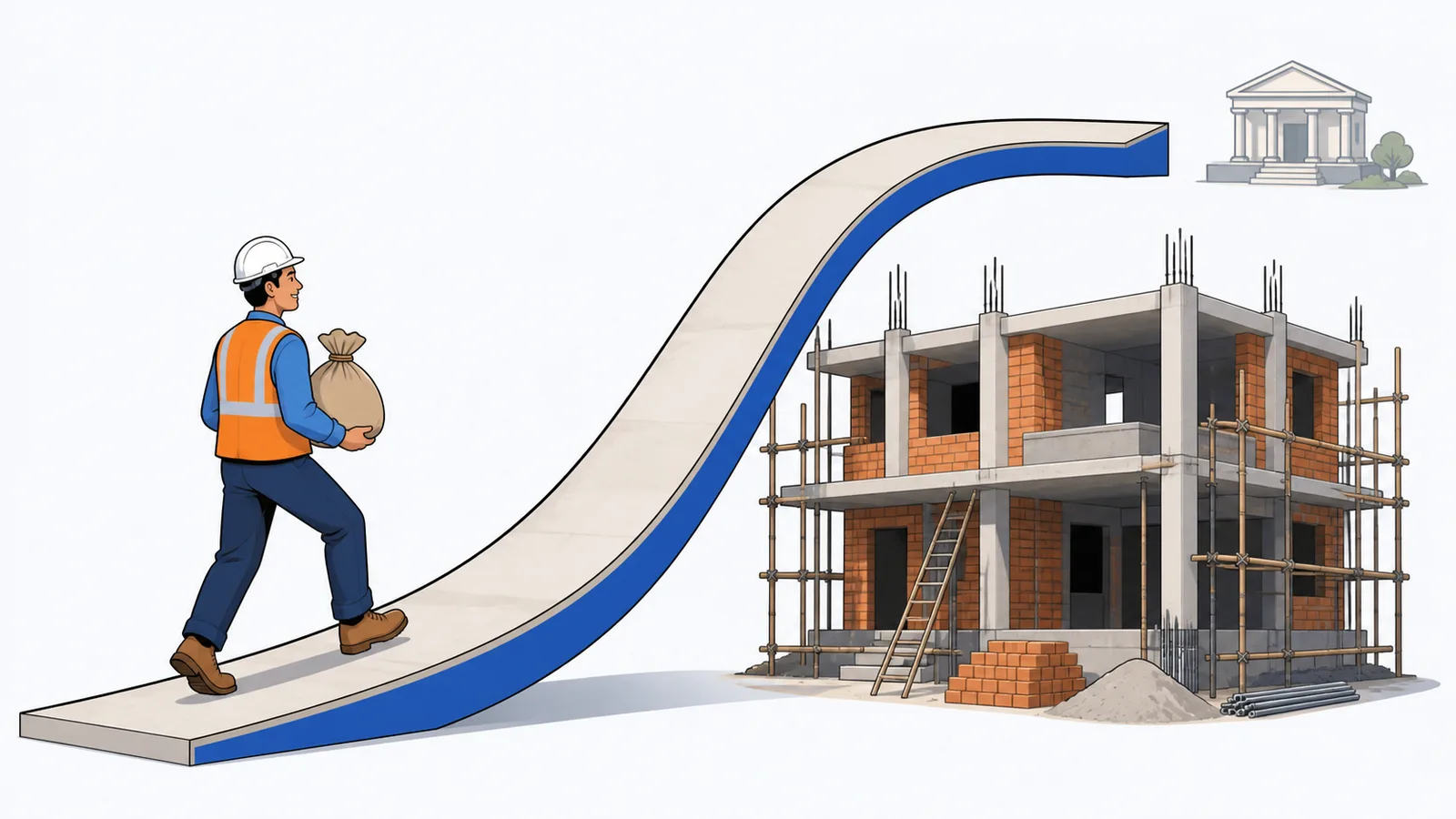
A budget answers "how much". It says nothing about "when" — and "when" is what stops sites. A perfectly estimated duplex still stalls if the roof-slab month demands ₹4 lakh while the bank tranche lands three weeks after casting. Indian self-builds die of this exact timing gap far more often than of bad estimates: the thekedar's gang is standing, the centering material is on rent, the dealer wants his cycle cleared — and the money is "coming". The cure is a monthly cash-flow projection, and the shape it always draws has a name: the S-curve.
Why spending makes an S
Cumulative project spend is slow at both ends and steep in the middle:
- Slow start (months 1–3): mobilization, excavation, foundations — important work, modest bills.
- Steep middle (months 4–9): the expensive overlap — slabs being cast while masonry follows one floor below, conduits going in, big material consignments arriving. Half the project's money commonly moves in four to five months.
- Taper (months 10–12): finishing trades, fittings, snag-fixing — many small bills, few big ones.
Plot cumulative spend against time and this slow-fast-slow pattern draws an S. Every healthy building project draws roughly the same curve; a project whose actual curve departs from its planned one is telling you something specific, early, and in rupees.
Worked example: monthly projection for the duplex
Spread the ₹33,60,000 construction cost (stage plan from Lesson 2) across the 12-month schedule, month by month. The percentages come from mapping each stage's spend across its calendar window, including the phased electrical/plumbing spends inside slab months:
| Month | Work in progress | Monthly outflow | Monthly % | Cumulative | Cum. % |
|---|---|---|---|---|---|
| 1 | Mobilization, excavation | ₹1,00,800 | 3% | ₹1,00,800 | 3% |
| 2 | Footings, plinth beams | ₹2,01,600 | 6% | ₹3,02,400 | 9% |
| 3 | Plinth done, GF columns | ₹2,68,800 | 8% | ₹5,71,200 | 17% |
| 4 | GF slab prep and cast | ₹3,36,000 | 10% | ₹9,07,200 | 27% |
| 5 | FF columns, GF masonry starts | ₹3,69,600 | 11% | ₹12,76,800 | 38% |
| 6 | FF slab cast | ₹4,03,200 | 12% | ₹16,80,000 | 50% |
| 7 | Staircase, parapet, masonry | ₹4,03,200 | 12% | ₹20,83,200 | 62% |
| 8 | Masonry done, plaster, wiring | ₹3,69,600 | 11% | ₹24,52,800 | 73% |
| 9 | Plaster done, flooring starts | ₹3,02,400 | 9% | ₹27,55,200 | 82% |
| 10 | Flooring, doors-windows, plumbing fixtures | ₹2,68,800 | 8% | ₹30,24,000 | 90% |
| 11 | Painting, electrical fittings | ₹2,01,600 | 6% | ₹32,25,600 | 96% |
| 12 | Snags, cleanup, handover | ₹1,34,400 | 4% | ₹33,60,000 | 100% |
Three numbers to pull out of this table and pin above your desk:
- Peak burn: ₹4,03,200 per month (months 6–7). Whatever your financing looks like, it must survive two consecutive months of this.
- The 50 percent point lands at month 6 — half the money goes in the first half only because the steep middle is balanced; on a delayed project the 50 percent point slides late and the middle gets steeper.
- Months 4–9 consume 65 percent of the construction cost. This is the window where a funding hiccup does real damage.
The bank-tranche gap
Recall from Lesson 2: construction-loan tranches are released after stage verification. Overlay that on the S-curve and a structural gap appears — you spend up the curve, the bank reimburses in steps behind it. An illustrative overlay for this duplex (loan ₹27 lakh, tranches per the Lesson 6 schedule): by end of month 5 you have spent about ₹12.8 lakh on construction plus roughly ₹1.6 lakh of early soft costs, while tranches received total about ₹12.15 lakh — a bridge of over ₹2 lakh, plus you must fund month 6's ₹4 lakh burn before the next verification. Practical rule: keep a float of 1 to 1.5 months of peak burn (₹5 – 6 lakh here) in liquid form from day one. Dealer credit (the 30–45 day cycles from Lesson 3) is part of this float in practice — but treat it as borrowed time with a price, not free money.
Reading the curve while the project runs
Update actual cumulative spend monthly and plot it against plan. The comparisons do real diagnostic work:
- Actual above plan, progress on schedule → prices or quantities are running hot; check the CBS to see which resource class.
- Actual above plan, progress behind → the dangerous quadrant: you are spending faster than you are building. On Indian sites this is classically advance creep — mobilization advance to the thekedar, advances to the fabricator, tiles booked and paid — money ahead of work. A small mobilization advance is common practice; keep it capped, recover it against early bills, and never let total advances exceed the value of verifiable work plus materials on site.
- Actual below plan, progress behind → the site is slowing (monsoon, labour exodus, a stalled decision) — expect the compressed steep middle to cost more later.
- Actual below plan, progress ahead → enjoy it; it almost never happens.
How this protects your money in a dispute
The monthly planned-vs-actual record is quiet paperwork until something goes wrong — then it is the whole case. When a bank tranche stalls on a technicality, a dated S-curve with stage photos and utilization statements is what gets the branch to move, because it speaks the bank's own language of verified progress. When a thekedar claims "payment delay stopped the work", your record shows payments tracking verified work month by month — or shows his advances running ahead of output, which reverses the conversation. And in the RERA era the same artifact is institutional practice: developers report progress against plan to justify escrow withdrawals; a self-builder keeping the identical record is simply using professional machinery at household scale. The habit costs one hour a month. The first dispute it wins pays for the whole course.
Common mistakes
- Flat-line budgeting. Dividing ₹33.6 lakh by 12 into "₹2.8 lakh per month" understates the real months 6–7 by 44 percent — the single most common cash-planning error on self-builds.
- Forgetting advance-heavy items. Doors, windows, modular kitchen and lifts are paid substantially before they appear on site; their cash leaves earlier than their stage suggests.
- Ignoring the monsoon. In much of India, months with sand restrictions and casting slowdowns flatten the curve mid-project and steepen it after — shift the plan, not just the hope.
- Tracking payments instead of liabilities. A bill you have received but not paid is money already spent in cost terms; track committed cost, not just bank debits, or the curve flatters you until it suddenly does not.
Where this goes next
You now hold every component: thumb-rule sanity checks, a staged plan, a resource breakdown, priced risk, and a monthly cash projection. The final lesson assembles all of it into one complete, bank-ready budget for the G+1 duplex — the artifact this module exists to teach.
Key takeaways
- Cumulative construction spend is slow-fast-slow — the S-curve — and months 4–9 of a 12-month house build commonly consume about two-thirds of the money.
- Plan cash by month from the stage plan, never by dividing the total equally — the flat-line average understates peak-burn months by over 40 percent.
- Peak burn for the ₹33.6 lakh duplex is ₹4.03 lakh per month; financing must survive two consecutive months of it.
- Bank tranches follow verified stages, so the owner bridges every stage — keep a liquid float of 1–1.5 months of peak burn from day one.
- Spent-percent above progress-percent is the danger quadrant — on Indian sites usually advance creep; cap and recover every advance against verified work.
- A dated planned-vs-actual record is what moves a stalled bank tranche and wins the 'payment delay stopped work' argument.
Verify on site
- Update actual cumulative spend (committed cost, not just payments) on the last day of every month.
- Plot actual against the planned S-curve and classify the month into one of the four quadrants before releasing new payments.
- Reconcile total advances outstanding against value of verified work plus materials on site — advances must never lead.
- Check float: liquid funds plus undrawn tranche must cover at least the next month's planned burn.
- Log dealer credit utilization and due dates alongside the cash plan — credit is float with a deadline.
- Before monsoon, re-time slab casts and sand-dependent stages and re-issue the monthly plan.
Check your understanding
4 questions. Answering them marks this lesson complete — results stay on your device.
Want the free certificate?
The whole course is free and open — no signup needed to learn. Enter your details only if you want us to track your progress on this device and issue a named certificate after the final assessment.