Common BOQ Mistakes That Cause Disputes
Lesson 26 of 60 · 6 min read
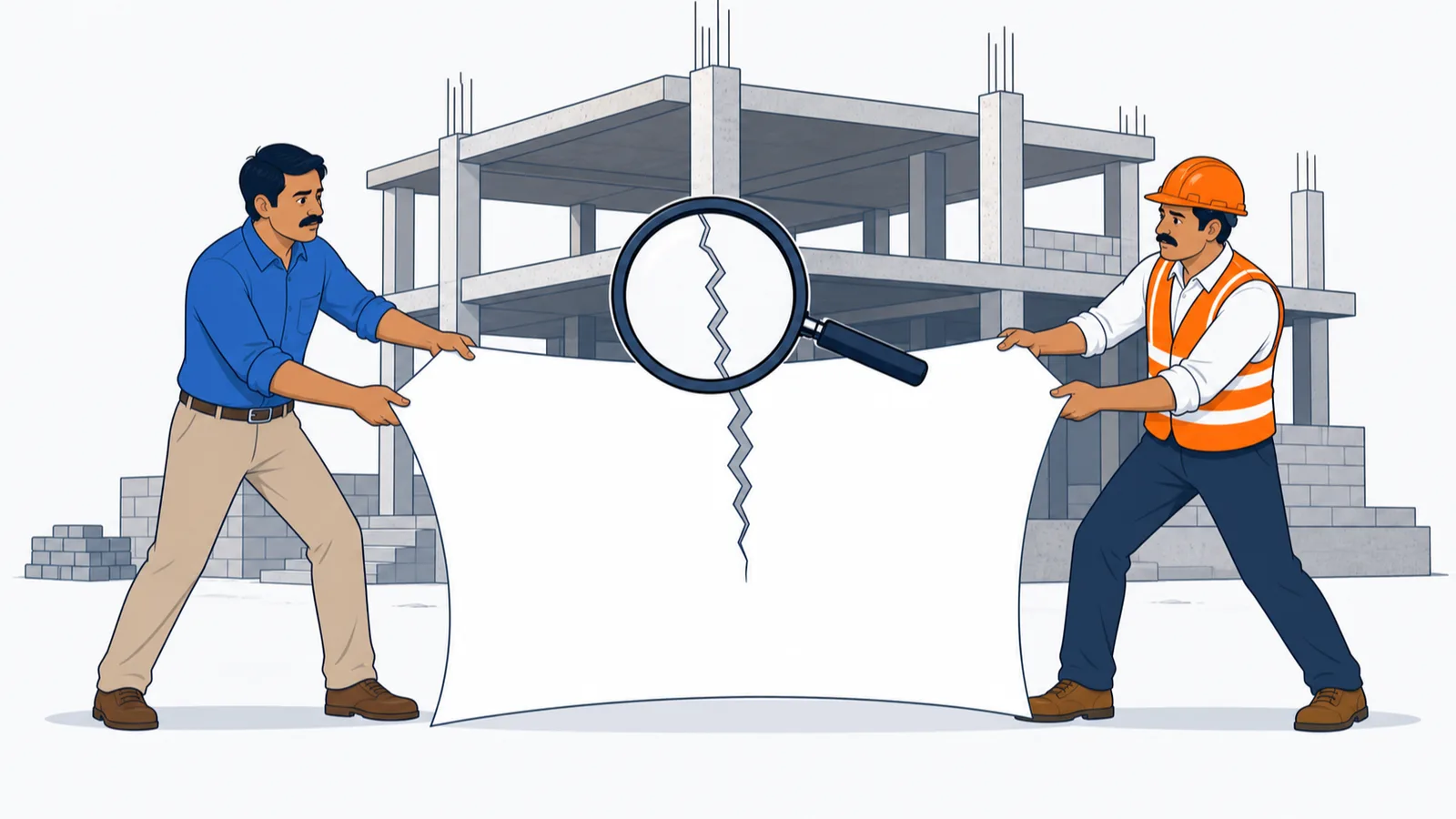
Very few construction disputes are actually about workmanship. Most are about money someone believed was included and someone else believed was extra — and that belief was created months earlier by a BOQ cell. This closing lesson catalogues the ten mistakes that generate those fights, with the approximate rupee damage of each on a typical G+1 residential project, so you can weigh a minute of drafting against a month of argument.
The composite-rate trap (the big one)
Mistake 1: "RCC work — Rs. 7,670/m3" with no scope line. From Lesson 4 you know Rs. 7,670 is a defensible concrete-only rate. The client, reading the same cell, believes it includes steel and shuttering — because "RCC" contains the word "reinforced". Watch the same physical m3 priced both ways (indicative rates from this module):
| Reading | Build-up | Per m3 |
|---|---|---|
| Concrete only | Lesson 4 analysis | Rs. 7,670 |
| Composite, typical slab-beam mix | concrete 7,670 + steel ~100 kg x Rs. 78 = 7,800 + shuttering ~5 m2 x Rs. 420 = 2,100 | ~Rs. 17,570 |
The same cell can honestly mean either number, and they differ by a factor of about 2.3. On a 60 m3 frame that ambiguity is worth roughly Rs. 5.9 lakh — comfortably the most expensive missing sentence in residential construction. Fix: every concrete item ends with "excluding reinforcement and formwork, measured separately" (or the composite scope is spelled out and the steel content capped).
Units and measurement mistakes
Mistake 2: mixed unit systems. The BOQ says m3; the thekedar talks in "brass" (in western India, 1 brass = 100 cft = 2.83 m3 — the same word is also used for 100 sqft of surface work, which is exactly the problem); the client thinks in sqft. Every verbal rate then needs a conversion nobody writes down. A quoted "Rs. 3,500 per brass" for excavation is Rs. 1,237/m3 if brass means 100 cft — but if one party mentally used 100 sqft of 1 m-deep pit, the numbers diverge by a factor of 3.5. Fix: SI units in every cell, and a preamble line: "all verbal or regional units are void; this BOQ measures per IS 1200".
Mistake 3: no deduction rules stated. Openings in masonry and plaster are the classic fight: the contractor bills gross wall area; the owner deducts every window. IS 1200 parts prescribe thresholds below which no deduction is made (and compensating conventions for jambs and reveals) — but only if the BOQ invokes them. On a house with 25 openings the gross-vs-net gap on masonry plus two plaster faces routinely reaches Rs. 40,000–80,000. Fix: "measured net per IS 1200; deductions per the relevant part" in the preamble.
Mistake 4: quantity padding as hidden contingency. Inflating takeoff quantities "to be safe" in an item-rate contract simply pre-authorises over-billing — actuals are paid against measurement anyway, and the padded BOQ destroys your cost plan's credibility. Keep quantities honest; carry risk in the visible contingency line (Lesson 6).
Missing-item mistakes
Mistake 5: the unpriced periphery. The items nobody writes: dewatering, backfill compaction in layers, anti-termite treatment, scaffolding, curing compound where water is scarce, debris disposal, cutting-and-making-good after conduits. Each surfaces mid-project as an "extra" priced under duress — and rates negotiated under duress run 30–50 percent above competitive rates. On a G+1 these forgotten items commonly total Rs. 1.5–3 lakh. Fix: walk a standard trade checklist against your BOQ before issue (the Module 2 and 3 takeoff sequences double as that checklist).
Mistake 6: no rate basis for extras. When (not if) extra items arise, on what rate? Silence means a fresh negotiation with zero leverage mid-pour. Fix: one clause — "extra items priced by rate analysis per the contract's method, or DSR-plus/minus the contract percentage where applicable" (Lesson 5 gave you both engines).
Arithmetic and money mistakes
Mistake 7: the abstract that does not total. A typed value over a formula, a section left out of the grand total, a copy-paste row counted twice. Beyond the direct error, a non-totalling abstract poisons trust in every other number you produced. Fix: Lesson 6's rules — formulas only, sections rolled up, one manual re-addition before issue.
Mistake 8: GST ambiguity. "Rs. 45 lakh total" — inclusive or exclusive? At the commonly applied 18 percent works-contract rate the gap is Rs. 8.1 lakh, the single largest number in this lesson, and it is created by omitting three words. Composition-scheme contractors, material-vs-service splits and input-credit positions all change the effective burden — this is commonly applied practice, not tax advice; confirm treatment with your CA and write it into the contract. Fix: every total carries "plus GST as applicable" or "inclusive of GST", never neither.
Mistake 9: rate-quantity mismatch on remeasure. An item-rate BOQ quoted against 100 m2 of flooring that becomes 160 m2 on remeasure, with no variation clause: the contractor claims the unit rate no longer holds (his fixed costs were spread over 100), the owner claims a rate is a rate. Standard contracts cap this (rates hold within a stated percentage variation of quantity); private BOQs usually forget the clause. Fix: borrow it — "rates firm for quantity variations up to +/-25 percent per item; beyond that, either party may seek re-analysis" (commonly applied convention; set your own threshold).
Mistake 10: no validity date. A BOQ priced in March, signed in August, after a cement and steel move. Fix: "rates valid 60 days from date of issue; thereafter material lines subject to re-quotation" — and Module 5's escalation lesson picks this thread up properly.
The pattern behind all ten
Every mistake above is a silence — about scope, unit, deduction, basis, tax, or time. And silences now cost more than they used to: the RERA era settled the question of how Indian construction disputes get decided — on documents. Whether the forum is a RERA authority, an arbitrator, a consumer commission or just a tense sit-down with the thekedar's seth, the written BOQ is read literally and the silence is construed against whoever should have spoken. The BOQ that prevents disputes is not the one with clever rates; it is the one where every cell answers the question a hostile reader would ask. Draft against the hostile reader: hand your BOQ to a colleague with the instruction "find the cell you could argue about" — at the cost of one chai, this is the cheapest arbitration you will ever run. Then fix the cell, not the colleague.
Common mistakes (the meta-list)
- Issuing the BOQ without a preamble — the one page that closes mistakes 2, 3, 8 and 10 simultaneously.
- Treating the BOQ as an estimate document instead of a contract document — it is both, and the contract reading always wins in a fight.
- Letting the lowest bid win before normalising all bids to the same scope, units and tax basis.
- Never revisiting the BOQ after signing — it is the baseline for every RA bill and variation in Module 7.
What comes next
This module gave you rates you can defend and a BOQ that defends itself. Module 5 zooms out from items to the whole project: budgeting by stage, thumb rules and when they lie, contingency sizing, escalation and the cash-flow curve — turning your defensible BOQ into a plan you can actually finance.
Key takeaways
- Every recurring BOQ dispute is a silence — about scope, unit, deduction, rate basis, tax or validity — and each has a one-line drafting fix.
- The costliest silence: a concrete-only RCC rate (~Rs. 7,670/m3) read as composite (~Rs. 17,570/m3 with steel and shuttering) — about Rs. 5.9 lakh of ambiguity on a 60 m3 frame.
- GST ambiguity on a Rs. 45 lakh contract is worth Rs. 8.1 lakh at the commonly applied 18% — every total must say inclusive or plus-GST (confirm treatment with your CA/contract).
- State deduction rules by invoking IS 1200 in the preamble; gross-vs-net openings on one house is a Rs. 40,000–80,000 argument.
- Price the periphery before it becomes a duress extra: dewatering, scaffolding, disposal, curing — duress rates run 30–50% above competitive.
- Add a quantity-variation clause (rates firm within a stated +/- band) and a rate validity date; both are standard-contract borrowings that private BOQs forget.
Verify on site
- Read every concrete item and confirm it says excluding (or explicitly including) reinforcement and formwork.
- Confirm every total in the contract states GST treatment in words.
- Check the preamble invokes IS 1200 for measurement and deductions.
- List ten likely extra items for your project and confirm each is either priced or covered by the extras clause.
- Verify the quantity-variation band and rate validity date exist before signatures.
- Have a colleague hostile-read the BOQ and argue one cell — fix what they find.
Check your understanding
4 questions. Answering them marks this lesson complete — results stay on your device.
Want the free certificate?
The whole course is free and open — no signup needed to learn. Enter your details only if you want us to track your progress on this device and issue a named certificate after the final assessment.