Rate Analysis Worked Examples: RCC, Brickwork, Plaster
Lesson 23 of 60 · 8 min read
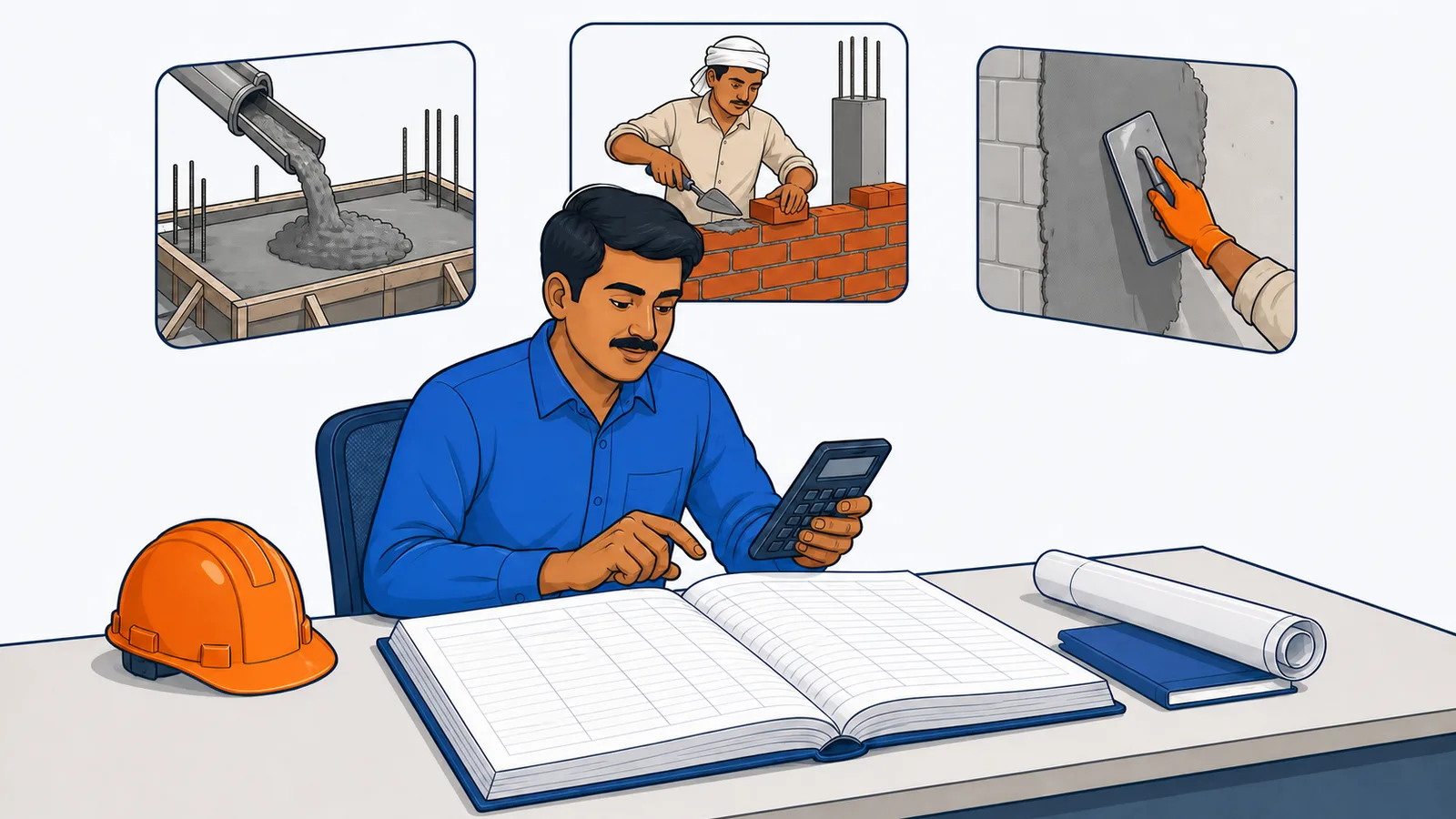
This is the lesson where the course stops describing rate analysis and does it — three complete build-ups for the items that together form 60–70 percent of a typical residential BOQ. Work through each table with a calculator. Every constant comes from Lessons 2 and 3; every percentage is labelled with its convention. All prices are indicative mid-2026 market ranges — always substitute your city's current quotations; the structure, constants and arithmetic method are what you are learning here.
Price assumptions used throughout (state yours the same way at the top of any analysis you issue): cement Rs. 380/bag, sand Rs. 1,600/m3, aggregate 20 mm Rs. 1,100/m3, bricks Rs. 8 each, mason Rs. 1,000/day, mazdoor Rs. 650/day, bhisti Rs. 650/day. One India-specific wrinkle: the material dealer's credit cycle moves these numbers. A cement price on 30-day udhaar (dealer credit) typically runs Rs. 5–15 per bag above the cash rate, and contractors who float projects on dealer credit quietly build that spread into their rates — so when you compare quotations, ask whether material prices are cash or credit terms, and compare like with like. Percentages as commonly applied in CPWD-style analysis: water charges 1 percent on the materials + labour + plant subtotal, then contractor's profit and overheads 15 percent on the result.
Example 1: RCC M20 (1:1.5:3), machine mixed and vibrated — per m3
Scope note first, because this is where quotations diverge: this rate covers concrete only — mixing, placing, compacting, curing. Steel and shuttering are separate BOQ items (billed in kg and m2 respectively). A composite "RCC including steel and shuttering" rate is a different, much larger number — Lesson 7 shows how confusing the two triggers disputes.
| # | Component | Qty | Unit | Rate (Rs.) | Amount (Rs.) |
|---|---|---|---|---|---|
| A | Materials | ||||
| A1 | Cement (1.54/5.5 = 0.28 m3 = 403 kg) | 8.06 | bag | 380 | 3,062.80 |
| A2 | Sand (coarse, screened) | 0.42 | m3 | 1,600 | 672.00 |
| A3 | Aggregate 20 mm graded | 0.84 | m3 | 1,100 | 924.00 |
| Materials subtotal | 4,658.80 | ||||
| B | Labour | ||||
| B1 | Mason (placing, finishing) | 0.17 | day | 1,000 | 170.00 |
| B2 | Mazdoor (mixing, transport, placing) | 2.00 | day | 650 | 1,300.00 |
| B3 | Bhisti / curing water handling | 0.50 | day | 650 | 325.00 |
| Labour subtotal | 1,795.00 | ||||
| C | Plant and tools (mixer + needle vibrator hire, fuel, share per m3) | 150.00 | |||
| D | Subtotal A + B + C | 6,603.80 | |||
| E | Water charges @ 1% of D (commonly applied) | 66.04 | |||
| F | Subtotal D + E | 6,669.84 | |||
| G | Contractor's profit and overheads @ 15% of F (CPWD convention; private 10–25%) | 1,000.48 | |||
| Rate per m3, say Rs. 7,670 | 7,670.32 |
Sanity checks worth memorising: materials are about 61 percent of this rate, labour about 23 percent, and cement alone about 40 percent. If a quoted M20 rate is far below yours, the money is usually coming out of line A1 — fewer bags than 8 per m3 — or out of curing.
With 100 percent RMC instead of site mixing, lines A and C collapse into the RMC invoice price plus pumping, and labour drops to placing-finishing-curing only; rebuild the table rather than patching it.
Example 2: Brickwork in CM 1:6, superstructure, 230 mm wall — per m3
| # | Component | Qty | Unit | Rate (Rs.) | Amount (Rs.) |
|---|---|---|---|---|---|
| A1 | Bricks (conventional size, incl. ~5% breakage inside the 500 count convention) | 500 | no | 8 | 4,000.00 |
| A2 | Cement (0.30 m3 dry mortar / 7 = 62 kg) | 1.25 | bag | 380 | 475.00 |
| A3 | Sand (6/7 x 0.30, say with handling losses) | 0.27 | m3 | 1,600 | 432.00 |
| Materials subtotal | 4,907.00 | ||||
| B1 | Mason | 0.90 | day | 1,000 | 900.00 |
| B2 | Mazdoor (incl. curing) | 1.80 | day | 650 | 1,170.00 |
| Labour subtotal | 2,070.00 | ||||
| C | Sundries (scaffolding share, tools) | LS | 75.00 | ||
| D | Subtotal A + B + C | 7,052.00 | |||
| E | Water charges @ 1% | 70.52 | |||
| F | Subtotal | 7,122.52 | |||
| G | CP&OH @ 15% | 1,068.38 | |||
| Rate per m3, say Rs. 8,190 | 8,190.90 |
Notice bricks alone are nearly half this rate — which is why the per-brick price and the regional brick-count constant (Lesson 2) dominate masonry economics. A Rs. 1 change in brick price moves the rate by about Rs. 575 per m3 after percentages.
Example 3: Cement plaster 12 mm, CM 1:6, internal — per m2 (built per 10 m2)
Plaster is measured in m2 (IS 1200 convention for thin surface work), but the arithmetic is cleaner per 10 m2 — divide at the end.
| # | Component (per 10 m2) | Qty | Unit | Rate (Rs.) | Amount (Rs.) |
|---|---|---|---|---|---|
| A1 | Cement (10 x 0.012 x 1.33 = 0.16 m3 dry + 5% wastage = 0.168; /7 = 0.024 m3 = 34.5 kg) | 0.69 | bag | 380 | 262.20 |
| A2 | Sand (6/7 x 0.168) | 0.144 | m3 | 1,600 | 230.40 |
| Materials subtotal | 492.60 | ||||
| B1 | Mason (gang norm 40 m2/day: 3 masons per 40 = 0.75/10 m2) | 0.75 | day | 1,000 | 750.00 |
| B2 | Mazdoor | 0.75 | day | 650 | 487.50 |
| B3 | Bhisti (curing) | 0.25 | day | 650 | 162.50 |
| Labour subtotal | 1,400.00 | ||||
| C | Sundries (screeds, tools, internal scaffolding share) | LS | 30.00 | ||
| D | Subtotal | 1,922.60 | |||
| E | Water charges @ 1% | 19.23 | |||
| F | Subtotal | 1,941.83 | |||
| G | CP&OH @ 15% | 291.27 | |||
| Per 10 m2 | 2,233.10 | ||||
| Rate per m2, say Rs. 223 | 223.31 |
Plaster inverts the RCC pattern: labour is about 63 percent of the rate and materials only about 22 percent. That is why plaster rates vary between cities far more than concrete rates — they track wages, not cement. It also means surface preparation and rework discipline (Module 8) matter more to plaster cost than any material negotiation.
This lesson's rate build-ups drop straight into the downloadable rate analysis format — one sheet per item, same five-layer structure.
Reading the three examples together
| Item | Rate | Materials share | Labour share | Dominant lever |
|---|---|---|---|---|
| RCC M20 | ~Rs. 7,670/m3 | ~61% | ~23% | cement count and price |
| Brickwork CM 1:6 | ~Rs. 8,190/m3 | ~60% | ~25% | brick price and count |
| Plaster 12 mm | ~Rs. 223/m2 | ~22% | ~63% | wages and productivity |
When you must cut cost, this table tells you where negotiation has room and where it can only damage quality: squeezing a plaster rate attacks wages (feasible within limits); squeezing an RCC rate below the material floor attacks cement content (never acceptable).
These three tables are also your dispute armour. When a running-account bill (Module 7) arrives with M20 billed at Rs. 8,400 against an agreed Rs. 7,670, the worked analysis behind the agreed rate is what lets you refuse the difference in writing instead of splitting it "adjust ho jayega" style — and when the contractor claims a cement price rise, the analysis shows exactly how much of the rate cement is (Rs. 3,063 of Rs. 7,670), so a Rs. 20-per-bag rise justifies 8.06 x 20 x 1.01 x 1.15 = about Rs. 187 per m3, not the Rs. 730 being claimed. In the RERA era, where buyers can demand cost substantiation and every claim rides on paper, the party holding the dated build-up controls the adjustment.
Common mistakes
- Quoting the concrete-only RCC rate against a composite expectation (or vice versa). Always write the scope line above the table.
- Percentage order errors — applying 15 percent before the 1 percent, or 16 percent flat. Small per item, systematic across a BOQ.
- Copying these illustrative prices. The constants travel; the prices do not. Refresh every price against local quotations dated within the month.
- Dropping the plant line when site-mixing — the mixer does not run on goodwill — or keeping full mixing labour when switching to RMC.
- Rounding each line instead of the final rate. Round once, at the end, and say so ("say Rs. 7,670").
What comes next
You can now build a rate from scratch. The obvious question: why build one at all when the CPWD DSR publishes thousands of ready-made rates? The next lesson explains what the DSR is, what its rates contain, and exactly when to trust it over the market — and the market over it.
Key takeaways
- Worked M20 RCC rate (indicative mid-2026 prices): materials Rs. 4,659 + labour Rs. 1,795 + plant Rs. 150, +1% water, +15% CP&OH = about Rs. 7,670/m3, concrete only.
- The RCC rate excludes steel (per kg) and shuttering (per m2) — always write the scope line above the table before quoting or comparing.
- Brickwork CM 1:6 lands near Rs. 8,190/m3 with bricks alone almost half the rate; plaster lands near Rs. 223/m2 with labour ~63% of the rate.
- Cement is ~40% of an M20 rate — an implausibly cheap RCC quote is usually a cement cut, not efficiency.
- Apply percentages in order: subtotal, then +1% water charges, then +15% CP&OH; round once at the end, never line by line.
- The constants transfer between projects; the prices never do — refresh every price against quotations dated within the month.
Verify on site
- Rebuild these three tables with your city's current prices before using any number from this lesson.
- Count cement bags consumed against theoretical bags on the next pour day — the M20 constant is 8 bags/m3.
- Verify the vibrator is on site and running during pours — you priced it in the plant line.
- Confirm whether each received quotation is concrete-only or composite before comparing with your analysis.
- Check curing deployment daily for 7–14 days post-pour; you paid 0.5 bhisti-day per m3 for it.
Check your understanding
5 questions. Answering them marks this lesson complete — results stay on your device.
Want the free certificate?
The whole course is free and open — no signup needed to learn. Enter your details only if you want us to track your progress on this device and issue a named certificate after the final assessment.