Labour Constants and Real Productivity Norms
Lesson 22 of 60 · 7 min read
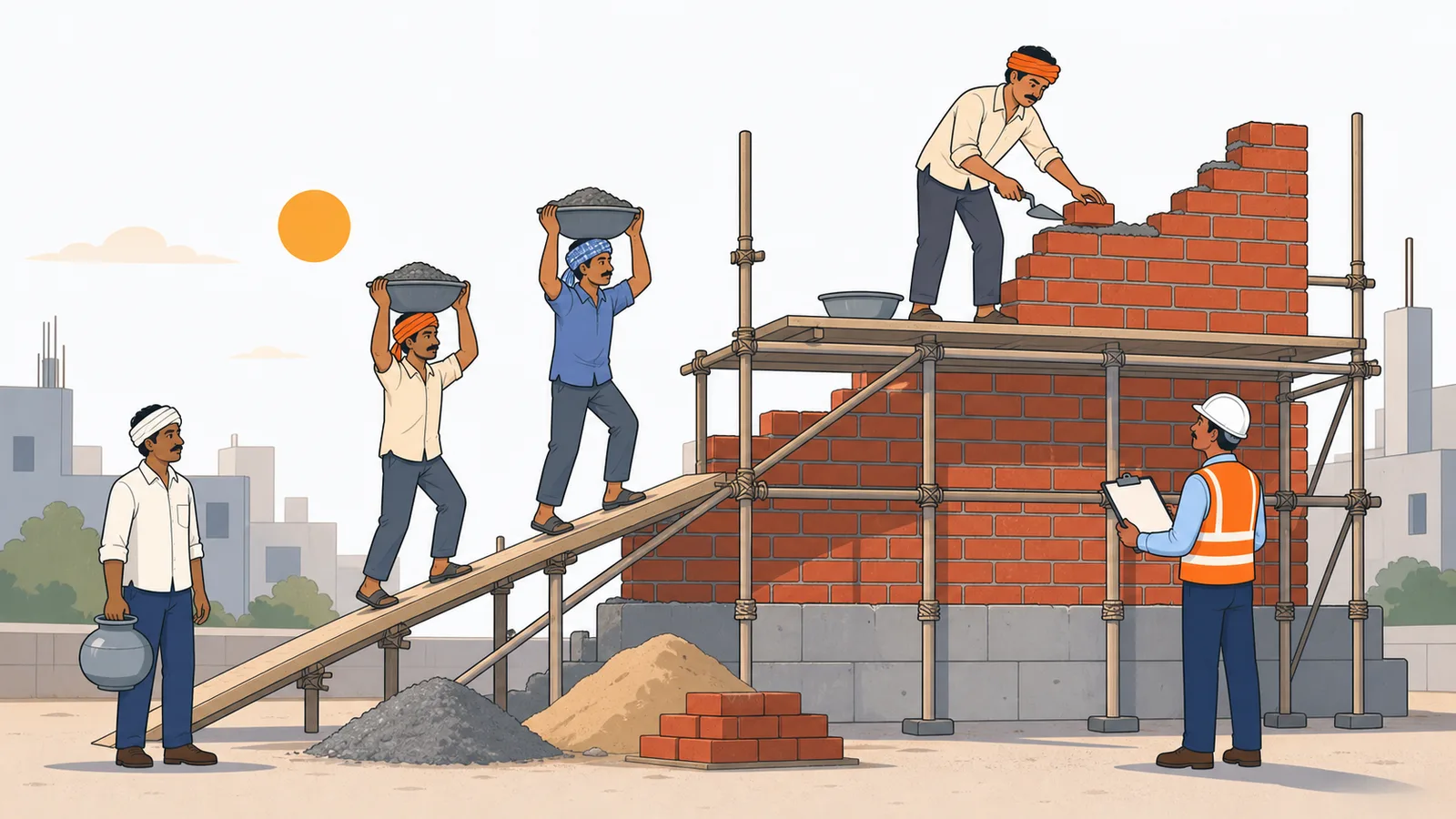
Two sites, same city, same drawing. On one, a mason gang finishes 30 m3 of brickwork in 16 days. On the other, the identical package drags to 26 days and the thekedar demands a rate revision. Neither site is lying — they are running different gang compositions, different material staging, and different supervision. Labour is the most variable line in any rate analysis, which is exactly why you must anchor it to explicit constants and then adjust openly, rather than absorbing a vague lump sum.
Labour constants: the vocabulary
A labour constant is the number of worker-days of each trade consumed per unit of finished work. Indian practice names three core categories:
- Mason (raj mistri) — skilled: lays bricks, finishes concrete, applies plaster.
- Mazdoor / beldar / coolie — unskilled: mixes, carries, stacks, cures.
- Bhisti — the water-carrier role; in modern billing this is effectively curing and water-handling labour.
Specialist trades (bar bender / blacksmith, carpenter for shuttering) appear in the items that need them. Classic estimating references and departmental analyses express constants either per unit of work (0.9 mason-day per m3) or as a gang out-turn (a defined gang produces X units per day). Both say the same thing; gangs are easier to check on site.
Commonly used norms (with their assumptions)
These are the ranges you will find across standard estimating texts and CPWD-style analyses. They assume materials staged within normal lead, working at normal height, and conventional (non-mechanised) methods — that assumption matters, and we correct for it below. Treat them as commonly applied norms, verify against your own site records; regional variation is real.
| Item | Unit | Mason | Mazdoor | Bhisti / curing | Gang check |
|---|---|---|---|---|---|
| PCC, mixed and laid | m3 | 0.10 | 1.4–1.8 | 0.2–0.3 | small gang lays ~2.8 m3/day |
| RCC, mixed, placed, vibrated (concrete only) | m3 | 0.17–0.25 | 2.0–2.5 | 0.5 | gang of ~7 places ~2.8–3.0 m3/day manually |
| Brickwork, superstructure, CM 1:6 | m3 | 0.8–1.0 | 1.3–1.8 | 0.15–0.25 | one mason lays 1.0 m3/day in superstructure, 1.25 m3/day in foundation |
| Plaster 12 mm, CM 1:6 | m2 | 0.07–0.10 | 0.07–0.10 | ~0.02 | 3 masons + 3 mazdoors + 1 bhisti do ~40 m2/day |
| Steel: cut, bend, tie, place | tonne | bar-bender pair | 5–10 pair-days | — | a bender + helper handle 100–200 kg/day |
| Shuttering, make and fix | m2 | carpenter 0.2–0.3 | 0.2–0.3 | — | varies strongly with repetition |
Note the deliberate width of these ranges. Old textbook norms (many trace to mid-century departmental studies) assume fully manual handling — head-load carriage, hand mixing in some cases. A site with a mixer, a material hoist and good staging beats them substantially; RMC with a pump removes the mixing-and-carrying labour altogether and replaces it with a pumping charge. Never mix norm systems: either price manual methods with manual constants, or mechanised methods with machine charges plus reduced labour.
Wages: indicative mid-2026 ranges
Daily wages vary sharply by city and season (indicative mid-2026 market ranges; metros at the top, tier-3 towns at the bottom; always use your local prevailing rates and respect the applicable state minimum wage):
| Trade | Indicative daily wage (Rs.) |
|---|---|
| Mason / bar bender / carpenter (skilled) | 900–1,200 |
| Mazdoor / helper (unskilled) | 550–750 |
| Bhisti / curing labour | 550–700 |
Departmental schedules use the notified minimum-wage scale of their base city — one reason DSR labour lines look low against metro market wages (Lesson 5 deals with this gap). On the ground, the daily-wage market clears at the morning naka (labour chowk): naka rates are the true spot price of labour in your town, they jump around festivals and harvest season, and a thekedar's piece rate is ultimately built on them plus his margin. Walk your naka once a month and note the mason and helper rates — that single habit keeps every labour line in your analyses honest.
Daily-wage constants vs piece rate: the same money, two languages
Most Indian residential sites do not actually pay masons per day for brickwork — they engage a labour thekedar at a piece rate (per sqft of wall, per m3, per sqft of built-up area). Rate analysis still matters because it tells you whether the piece rate is fair.
Worked example — 30 m3 of 230 mm brickwork.
Constants route (superstructure, mid-range constants):
| Line | Calc | Amount (Rs.) |
|---|---|---|
| Mason: 30 x 0.9 = 27 days | 27 x 1,000 | 27,000 |
| Mazdoor: 30 x 1.8 = 54 days | 54 x 650 | 35,100 |
| Labour cost, constants route | 62,100 (= Rs. 2,070/m3) |
Piece-rate route: the thekedar quotes Rs. 55 per sqft of 9-inch wall face, labour only.
| Step | Calc | Result |
|---|---|---|
| Per m2 of wall face | 55 x 10.764 | Rs. 592/m2 |
| Wall face per m3 of 230 mm wall | 1 / 0.23 | 4.35 m2/m3 |
| Per m3 equivalent | 592 x 4.35 | Rs. 2,575/m3 |
The quote is about 24 percent above the constants-based cost. That gap is the negotiation: some of it is the thekedar's supervision and margin (legitimate), some may be padding. You can now negotiate line-wise — or accept the rate but demand scaffolding and curing included, closing the gap in scope instead of price. Without the constants you had no position at all.
This same arithmetic is your defence when the dispute runs the other way. Mid-project, a thekedar demands a rate revision "because the work is slow". Constants let you separate the two possible truths: if your own site diary shows masons laying the normal 1.0 m3 a day, the rate stands and you can show why; if staging or drawing delays genuinely held them to 0.6 m3 a day, the revision is justified and you can size it — the mason line rises from 1.0 to 1.67 days per m3, about Rs. 670 extra, not the round Rs. 1,500 being demanded. Documented output data turns a shouting match into a measured adjustment, and it is equally persuasive before a PMC or in the written record RERA-era projects now expect.
Correcting norms for site reality
Productivity is not a constant of nature. Commonly observed corrections (site studies vary; use your own records where you have them):
- Monsoon: output drops on the order of 20–25 percent for outdoor trades.
- Extreme heat (above ~40 deg C): roughly 10–15 percent drop, plus mandated rest breaks.
- Height: every additional floor without a hoist adds carrying time; above G+2, manual-handling constants climb steeply.
- Repetition: the tenth identical slab cycle is much faster than the first — shuttering carpentry gains the most.
- Congestion and staging: a cramped plot where materials are double-handled can silently absorb 15–20 percent extra mazdoor time.
The professional habit: keep a simple site diary of gang size vs output for your three biggest trades (Module 8 formalises this). Three weeks of real data beats any book.
Common mistakes
- Using foundation out-turn for superstructure work. A mason lays about 25 percent more in foundation and plinth than in superstructure — height and scaffolding slow the upper floors.
- Pricing curing at zero. The bhisti-equivalent line is small per unit but real; omitting it is the classic silent leak from Lesson 1.
- Applying manual-era constants to mechanised work (or double-paying: mixer hire AND full manual mixing labour).
- Comparing wages across cities without comparing productivity. A costlier metro mason with proper staging often produces a cheaper per-unit rate.
- Treating the thekedar's all-in sqft rate as a labour constant. It bundles supervision, tools, margin and sometimes scaffolding — unbundle before comparing.
What comes next
You now hold both halves of a rate: material constants (Lesson 2) and labour constants (this lesson). The next lesson assembles them into complete, checkable rate analyses for the three items that dominate every residential BOQ — M20 RCC, brickwork and plaster.
Key takeaways
- A labour constant is worker-days per unit of finished work; a gang out-turn is the same number expressed as daily output — gangs are easier to verify on site.
- Anchor norms: brickwork ~0.8–1.0 mason-day/m3 (superstructure), 12 mm plaster gang ~40 m2/day, manual RCC gang ~2.8–3.0 m3/day — book norms assume manual handling.
- Indicative mid-2026 wages: skilled Rs. 900–1,200/day, unskilled Rs. 550–750/day — always use local prevailing rates and the applicable minimum wage.
- Convert piece rates (Rs./sqft) to per-m3 equivalents before comparing with constants-based costs; the gap is your negotiation, not a mystery.
- Correct norms for monsoon (−20–25%), extreme heat, height without a hoist, congestion and repetition — and keep your own gang-vs-output diary.
- Foundation out-turn is ~25% higher than superstructure for brickwork; using the wrong one misprices the whole masonry package.
Verify on site
- Record gang size and measured output daily for the three biggest trades on site.
- Confirm what the thekedar's piece rate includes: scaffolding, curing, tools, material shifting.
- Check material staging distance to each work front — double-handling silently inflates mazdoor time.
- Verify curing labour is actually deployed (and priced) for 7–14 days after each pour.
- Reconfirm labour rates at season change — monsoon and festival seasons move both wages and productivity.
Check your understanding
4 questions. Answering them marks this lesson complete — results stay on your device.
Want the free certificate?
The whole course is free and open — no signup needed to learn. Enter your details only if you want us to track your progress on this device and issue a named certificate after the final assessment.