Material Constants: Cement, Sand, Aggregate, Steel per Unit of Work
Lesson 21 of 60 · 8 min read
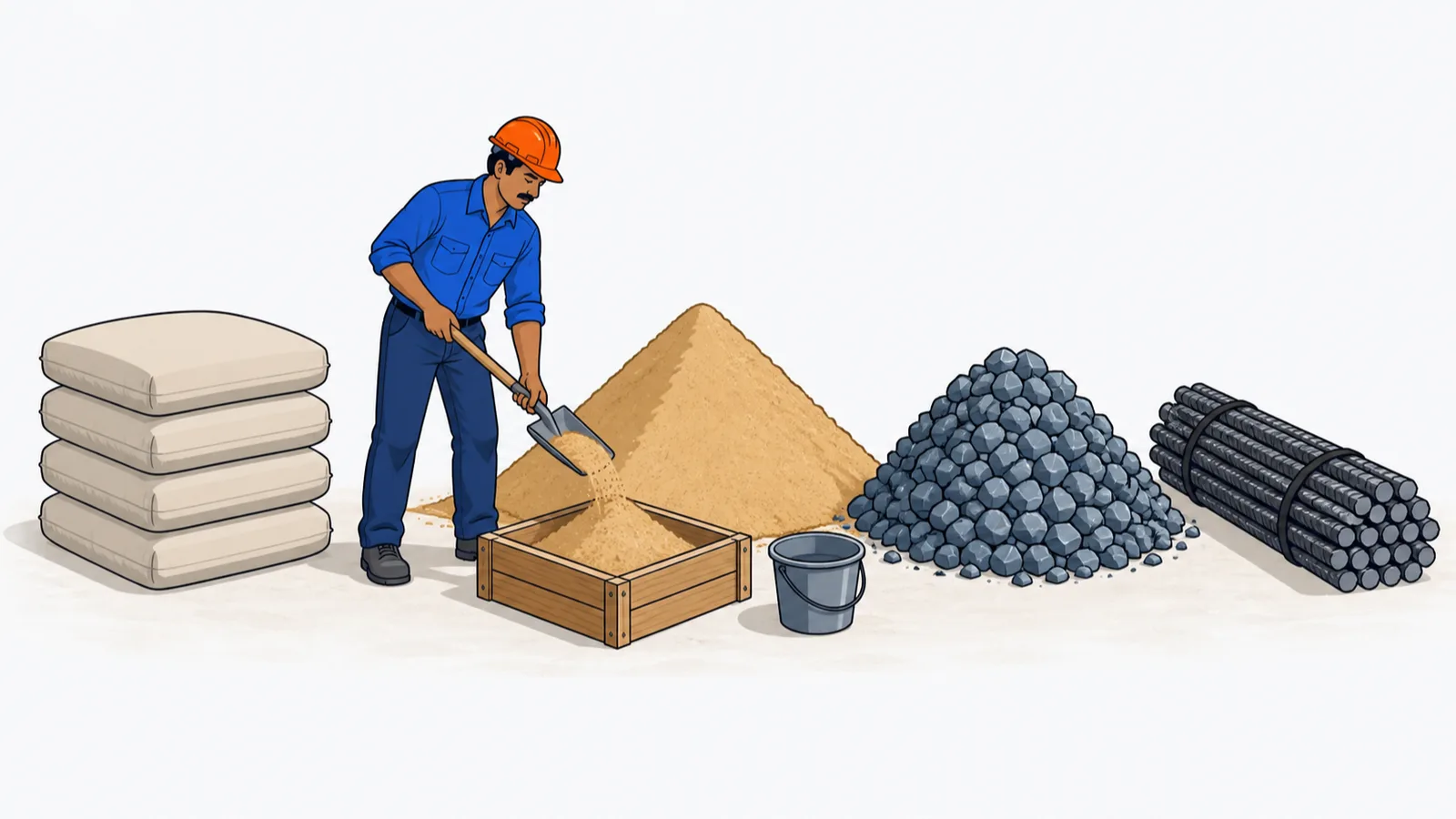
Order sand for a slab using the wet concrete volume and you will run short by a third — with the pump standing on hire and the mason gang idle. The gap between wet volume and dry material is the single most common material-ordering error on small sites, and it comes from not knowing (or not believing) two numbers: 1.54 for concrete and 1.33 for mortar. This lesson pins down those factors and the material constants they generate, so you can price and order any common item from memory.
Why dry volume is bigger than wet volume
Cement, sand and aggregate are batched loose and dry. Loose material is full of air voids, and damp sand is additionally bulked up by moisture films between particles. When you add water and compact the mix, the voids collapse: cement paste fills the spaces between sand grains, and mortar fills the spaces between aggregate pieces. So producing 1.00 m3 of finished, compacted concrete consumes roughly 1.52–1.54 m3 of loose dry ingredients. The convention in Indian estimating texts and schedule analyses is to use 1.54 (some use 1.52 or 1.57 — the physics is the same; state which factor you used).
For cement-sand mortar the same collapse happens without coarse aggregate, and the conventional factor is 1.33 (commonly quoted as 1.30–1.35): 1.00 m3 of placed mortar consumes about 1.33 m3 of dry cement and sand.
Two more conversion constants complete the toolkit:
- Cement bulk density: 1,440 kg per m3, so one 50 kg bag occupies 0.0347 m3 (about 1.226 cft).
- Steel density: 7,850 kg per m3, which gives the famous bar-weight formula below.
Cement bags per m3 of concrete, by mix
Apply the factor and split by mix proportion. For a nominal mix a:b:c, cement volume per m3 of concrete = 1.54 / (a+b+c) when batched by volume. Multiply by 1,440 kg/m3 and divide by 50 kg to get bags:
| Mix (nominal, by volume) | Typical use | Cement (bags/m3) | Sand (m3) | Aggregate (m3) |
|---|---|---|---|---|
| 1:5:10 | lean PCC below footings | ~2.8 | 0.48 | 0.96 |
| 1:4:8 | PCC levelling course | ~3.4 | 0.47 | 0.95 |
| 1:3:6 | PCC, mass fill | ~4.4 | 0.46 | 0.92 |
| 1:2:4 (M15) | non-structural RCC-era mix | ~6.3 | 0.44 | 0.88 |
| 1:1.5:3 (M20) | RCC slabs, beams, columns | ~8.1 (403 kg) | 0.42 | 0.84 |
| M25 and above | design mix only | per approved design, commonly 6.0–7.2 | per design | per design |
Worked check for M20: dry volume 1.54 m3; cement fraction 1/5.5; cement volume = 1.54/5.5 = 0.28 m3 = 0.28 x 1,440 = 403.2 kg = 8.06 bags. Sand = 1.5/5.5 x 1.54 = 0.42 m3; aggregate = 3/5.5 x 1.54 = 0.84 m3. Water is roughly 180 litres per m3 for a nominal M20.
Two honest caveats. First, IS 456 permits nominal mixes only up to M20; M25 and above require a design mix, where cement content comes from the approved mix design (often 300–360 kg/m3 with admixtures), not from this table. Second, even for M20 a design mix is preferred and usually leaner — the 8.1-bag figure is the conservative nominal-mix convention that most schedules and site orders still follow.
Brickwork constants (per m3, conventional 9-inch wall)
Using the traditional brick with mortar joints counting as 20 x 10 x 10 cm:
| Item | Constant (per m3 of brickwork) | Convention |
|---|---|---|
| Bricks | ~500 nos (494–500) | brick + joint = 0.002 m3 |
| Wet mortar | ~0.23–0.25 m3 | 1.00 minus actual brick volume |
| Dry mortar | ~0.30 m3 | wet x 1.33 |
| Cement, CM 1:6 | ~62 kg = ~1.25 bags | 0.30/7 x 1,440 |
| Cement, CM 1:4 | ~1.7–1.8 bags | 0.30/5 x 1,440 |
| Sand | ~0.26–0.30 m3 | dry mortar x ratio share |
Brick sizes vary regionally (modular 190 x 90 x 90 mm vs field sizes like 230 x 110 x 75 mm), which shifts the count anywhere from about 390 to 500 per m3 — measure a sample of your actual bricks before ordering, and add 5–8 percent for breakage. Region also decides the walling material itself: clay brick dominates the Gangetic belt where kilns are dense, while much of the south and west has shifted to AAC blocks and fly-ash bricks (different block counts, thinner mortar or adhesive, different constants — rebuild the table, do not force-fit the 500-brick convention). Sand tells the same regional story: river-sand mining bans and district-wise royalty on aggregates mean the sand line in your rate can vary two-fold between neighbouring states, and M-sand conventions differ again.
Plaster constants (per m2)
For 12 mm thick internal plaster in CM 1:6: wet mortar = 0.012 m3/m2; dry = 0.012 x 1.33 = 0.016 m3/m2; cement = 0.016/7 x 1,440 = ~3.3 kg (0.066 bag) and sand ~0.014 m3 per m2, before wastage. Site convention often adds 15–20 percent extra for uneven masonry faces and dubbing, taking cement toward 0.08–0.09 bag/m2 — state whether your constant includes this surface allowance. Ceiling plaster (6 mm, CM 1:3) and external 15–20 mm double-coat work have their own constants; scale by thickness and ratio using the same method.
Steel: the d-squared-by-162 rule
From density 7,850 kg/m3, the weight of a round bar per metre is (pi/4) x d2 x 7,850 / 10^6, which simplifies to:
Weight (kg/m) = d2 / 162 (d in mm)
| Bar dia | kg/m | Weight of one 12 m bar |
|---|---|---|
| 8 mm | 0.395 | 4.74 kg |
| 10 mm | 0.617 | 7.40 kg |
| 12 mm | 0.888 | 10.66 kg |
| 16 mm | 1.580 | 18.96 kg |
| 20 mm | 2.469 | 29.63 kg |
| 25 mm | 3.858 | 46.30 kg |
Reinforcement is always estimated and billed by weight (kg or tonne) from the bar bending schedule, plus 3–5 percent for offcut wastage and binding wire at roughly 7–10 kg per tonne of steel (commonly applied allowances; confirm your contract's convention).
Worked example: material order for a 25 m3 M20 slab
Your takeoff (Module 3) says the slab, beams and columns of a pour total 25 m3 of M20.
| Material | Constant | Theoretical | Wastage | Order quantity |
|---|---|---|---|---|
| Cement | 8.06 bags/m3 | 201.5 bags | +3% | 208 bags — order 210 |
| Sand | 0.42 m3/m3 | 10.5 m3 | +8% | 11.3 m3 — order 2 truckloads (approx. 12 m3) |
| Aggregate 20 mm | 0.84 m3/m3 | 21.0 m3 | +5% | 22.1 m3 — order 22.5 m3 |
| Water | ~180 l/m3 | 4,500 l | — | ensure tank capacity + curing water |
Round orders to supplier units (full truckloads, full bags) and record the rounding — the difference between ordered and theoretical quantity is exactly what Module 6's material reconciliation will track.
How constants protect your bill
These constants are your audit weapon. If a contractor working on a with-material basis bills you 260 bags of cement against 25 m3 of M20 plus 60 m3 of brickwork, you can check in two minutes: 25 x 8.06 + 60 x 1.25 = 201.5 + 75 = 276.5 theoretical bags — his claim is plausible. If he bills 340, you have a documented 23 percent gap to put on the table before signing. The same check runs in reverse when you supply materials to a labour-only thekedar: theoretical consumption for measured work is the number that decides whether cement is walking off your site. In the RERA era, buyers and financiers increasingly ask for exactly this reconciliation — the estimator who can produce theoretical-vs-actual on one page is the one whose bills clear without argument.
Common mistakes
- Ordering on wet volume — the 35 percent shortfall appears mid-pour, the worst possible time.
- Using the concrete factor for mortar or vice versa. Concrete 1.52–1.54; mortar 1.30–1.35. Mixing them up misprices every masonry and plaster item by around 15 percent.
- Trusting one bag = 1 cft. A 50 kg bag is 0.0347 m3 = 1.226 cft. The 1 cft shortcut understates cement volume by 18 percent in volumetric batching — use a proper farma box.
- Applying the 500-brick constant to non-standard bricks. Count and measure a sample; regional bricks can drop the constant below 400.
- Forgetting that M25+ is design mix. Quoting 1:1:2 "for M25" is a convention from old texts, not an IS 456-compliant basis for structural concrete.
What comes next
Materials are half of every rate. The other half is labour — and labour constants are where estimates vary most wildly between books, schedules and actual Indian sites. The next lesson gives you the norms and, more importantly, how to correct them for your site's reality.
Key takeaways
- 1 m3 of finished concrete consumes 1.52–1.54 m3 of dry loose material (convention: 1.54); mortar consumes 1.30–1.35 (convention: 1.33) — always state your factor.
- M20 nominal 1:1.5:3 needs about 8.1 bags (403 kg) cement, 0.42 m3 sand and 0.84 m3 aggregate per m3; leaner PCC mixes drop to 2.8–4.4 bags.
- IS 456 permits nominal mixes only up to M20 — M25 and above take cement content from the approved design mix, not from a ratio table.
- Conventional brickwork constants: ~500 bricks and ~0.30 m3 dry mortar per m3 (about 1.25 bags cement at CM 1:6) — recheck against your regional brick size.
- Bar weight = d2/162 kg per metre, from steel density 7,850 kg/m3; steel is always billed by weight with 3–5% wastage and binding wire allowances stated.
- One 50 kg cement bag = 0.0347 m3 (1.226 cft), at bulk density 1,440 kg/m3 — the '1 bag = 1 cft' shortcut understates cement by 18%.
Verify on site
- Measure a sample of the actual bricks on site and recompute the per-m3 brick constant before bulk ordering.
- Check sand for bulking: damp sand can occupy 20–30% more volume — press a handful; if it holds shape, account for bulking in volumetric batching.
- Verify farma (batching box) dimensions against the mix design — one bag of cement is 1.226 cft, not 1 cft.
- Cross-check the cement consumed on a pour day against theoretical bags for the measured volume — a gap above 5% needs an explanation.
- Confirm steel offcuts are stored and logged — the 3–5% wastage allowance is a budget, not a licence.
Check your understanding
5 questions. Answering them marks this lesson complete — results stay on your device.
Want the free certificate?
The whole course is free and open — no signup needed to learn. Enter your details only if you want us to track your progress on this device and issue a named certificate after the final assessment.