Safety Items That Belong in the Estimate
Lesson 51 of 60 · 7 min read
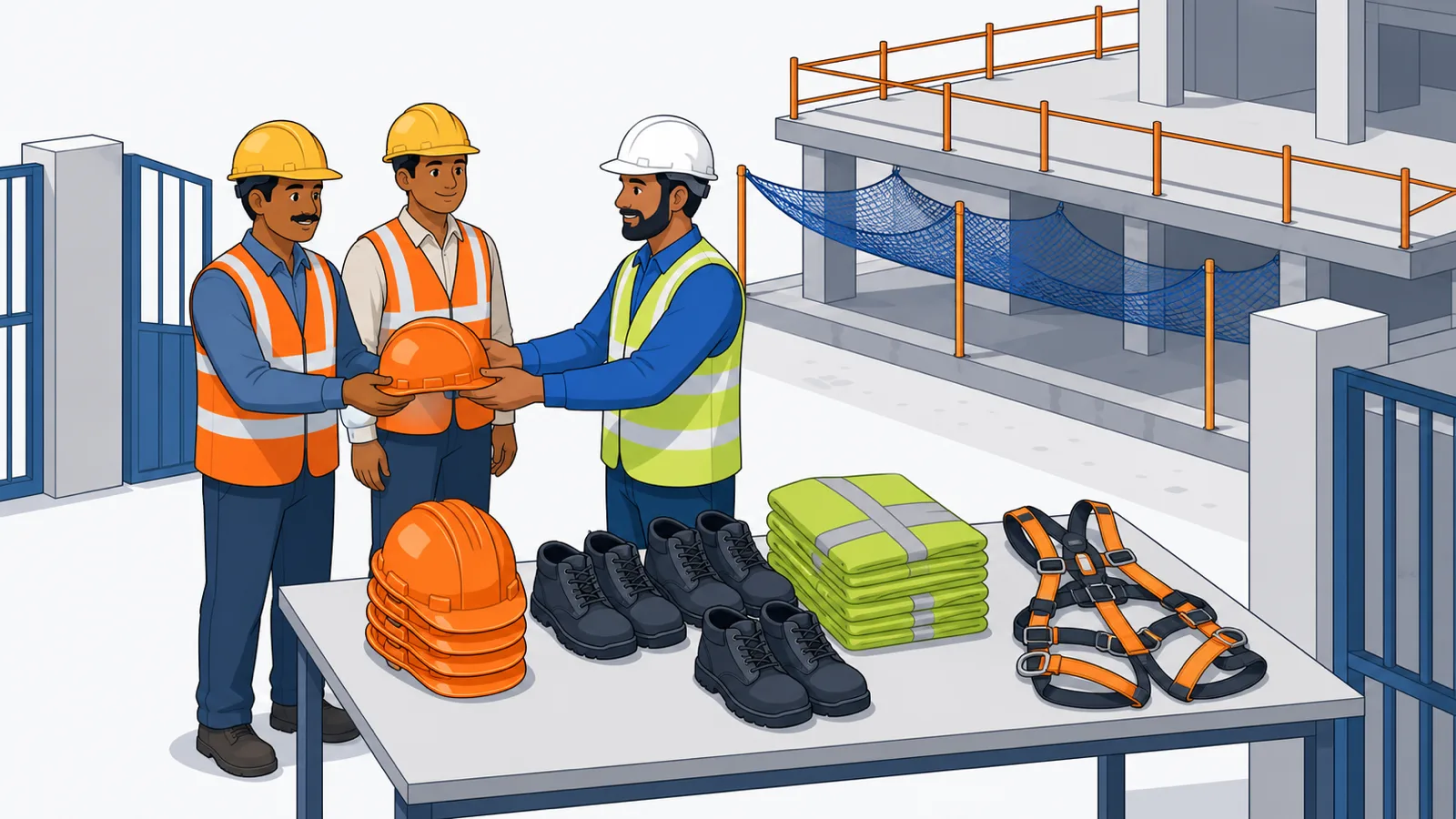
Ask why nobody on a site wears a helmet and you will eventually reach a QS decision: safety was never priced. The thekedar quoted labour rates that assume nothing is spent on it; the estimate carried no safety line; and now every net, guardrail and pair of shoes is an "extra" someone must volunteer to absorb. Nobody volunteers. The fix is unglamorous and entirely within the QS's power: put safety in the estimate as priced items, the way you price cement. This lesson lists what belongs there, with indicative mid-2026 rupee figures, and works a full safety budget for a real-sized project.
Why safety is a BOQ problem before it is a culture problem
Three structural facts of Indian sites make unpriced safety impossible in practice:
- Naka labour arrives with nothing. Daily-wage workers hired at the naka at indicative mid-2026 rates of Rs. 500–600 (helper) to Rs. 800–1,000 (mason) own no PPE and will not buy any from that wage. If the project does not issue helmets and shoes, they do not exist. Labour churn — the same naka, different faces next month — means reissue, so a realistic PPE budget is the headcount cost times roughly 1.5 over a project.
- The thekedar prices what is written. A labour contract that never mentions safety has, contractually, bought none. If nets and guardrails are the thekedar's scope, they must be named in his work order with a rate; if they are the owner's supply, they must be in the owner's estimate. Unwritten scope falls into the gap between the two — permanently.
- The law already assumes you budgeted it. The BOCW framework (commonly applicable to establishments engaging 10 or more building workers — confirm current central and state rules for your site) creates registration and welfare obligations, and the associated cess is commonly levied at 1 percent of the cost of construction (the statute permits 1–2 percent). This is commonly applied practice, not legal advice — confirm rates and applicability with your CA and local BOCW board. A Contractor's All Risks (CAR) insurance policy, indicatively 0.1–0.3 percent of contract value depending on cover, is the other standing line. Neither is optional-feeling once you have seen a site sealed by a stop-work notice.
The items, with indicative rates
Indicative mid-2026 figures; always use current local quotations:
| Item | Indicative rate |
|---|---|
| Helmet | Rs. 250–400 each |
| Safety shoes | Rs. 800–1,200 per pair |
| Hi-viz jacket | Rs. 150–250 each |
| Full-body harness with lanyard | Rs. 1,500–3,000 each |
| Safety net (supply + fixing) | Rs. 60–100 per m2 |
| MS pipe edge protection / guardrail | Rs. 120–180 per running metre |
| Fire extinguisher (ABC, 4–6 kg) | Rs. 2,500–4,000 each |
| First-aid kit (stocked) | Rs. 1,500–3,000 per site |
| Bilingual signage set (Hindi/regional + English) | Rs. 8,000–12,000 per site |
| Temporary electrical safety (ELCB/RCCB boards, cable management) | Rs. 15,000–30,000 per site |
Regional note on scaffolding: metro and organised-developer sites price MS cuplock or H-frame scaffolding with proper toe boards and tagging; across much of the East and North, bamboo scaffolding remains standard practice — cheaper per metre, but it still needs a competent erector, lashing checks and the same edge protection at slab boundaries. Price whichever system your region uses; price the guardrails either way.
Worked example: safety budget for a G+2
Project: G+2 residential, ~1,100 m2 built-up, 30 workers average, 14 months, contract value Rs. 1.8 crore.
| Item | Working | Amount |
|---|---|---|
| PPE (30 workers x ~Rs. 1,500 kit x 1.5 reissue) | 30 x 1,500 x 1.5 | Rs. 68,000 (rounded) |
| Safety nets, periphery of two slab levels | ~300 m2 x Rs. 80 | Rs. 24,500 (rounded) |
| Edge protection and stair guardrails | ~180 m x Rs. 150 | Rs. 27,000 |
| Scaffold safety upgrades (toe boards, ladders, tags) | lump sum | Rs. 20,000 |
| Fire extinguishers + first aid | 4 x 3,500 + 3,000 | Rs. 17,000 |
| Signage + induction/toolbox materials | 10,000 + 5,000 | Rs. 15,000 |
| Safety supervision (part allocation of engineer time) | Rs. 8,000/month x 14 | Rs. 1,12,000 |
| CAR insurance (indicative 0.25 percent) | 0.0025 x 1.8 crore | Rs. 45,000 |
| BOCW cess (commonly 1 percent — confirm) | 0.01 x 1.8 crore | Rs. 1,80,000 |
| Total | ~Rs. 5,08,500 |
About Rs. 5.1 lakh — roughly 2.8 percent of contract value. That is the honest number a "safety is included" estimate silently pretends is zero. Note the shape of it: the two statutory-and-insurance lines (cess + CAR) are more than 44 percent of the total and scale with contract value, while the physical items are surprisingly cheap — the entire PPE, nets, guardrails and fire/first-aid stack together costs less than one mid-range execution error from Lesson 4.
Where it sits in the estimate
Three workable structures, in rising order of enforceability:
- Percentage allowance (1.5–3 percent of cost) — better than nothing, but invisible money gets absorbed invisibly.
- A dedicated safety section in the BOQ with measurable items — nets per m2, guardrails per metre, PPE per head — payable against delivery. This is the structure organised developers and PMCs use, and it is the one this course recommends: what is itemised gets bought, what is measured gets billed.
- Itemised + record-linked: payment against the item requires the register that proves it — PPE issue register signed by workers, work-permit file for height/hot work, toolbox-talk attendance. This closes the loop where a thekedar bills the safety item and the helmets never reach the naka workers' heads.
How this protects your money
Safety pricing is dispute protection in three directions at once:
- Against silent scope-shedding: when the safety BOQ section exists, a thekedar's low quote that "forgot" nets is exposed in comparison — you are comparing like with like, and the cheap quote stops being cheap.
- Against the accident itself: an incident on an undocumented site lands on whoever has the deepest pockets, with stop-work weeks (every idle day of a 30-worker site burns roughly Rs. 18,000–20,000 in wages alone at naka rates), statutory compensation exposure, and — for a RERA-registered developer — a project timeline commitment that does not pause for the labour department. The priced-and-recorded version costs 2.8 percent; the unpriced version has no upper bound.
- In the billing file: work permits, PPE registers and toolbox records are certification evidence for safety line items, exactly as pour cards are for concrete. A safety item billed without its register is deniable; with it, it is a certified quantity like any other. Keep them in the same discipline: numbered, dated, signed.
Common mistakes
- Pricing safety as a single "lump sum — safety" line that nobody can measure, bill, or enforce.
- Assuming the thekedar's rate "includes" PPE because his quotation did not exclude it — unwritten scope does not exist.
- Buying one round of PPE and treating it as permanent; naka churn means issue is a flow, not a stock.
- Forgetting cess and insurance in the cost plan, then meeting them as "surprises" worth lakhs mid-project.
- Keeping no issue or permit registers — which converts real safety spending into an unbillable, unprovable cost.
Where this module leaves you
You can now measure work so it survives a dispute, paper a pour so quantity and quality are inseparable, accept or reject concrete on IS 456's actual numbers, price the execution errors before they happen, referee deviations with tolerance bands and NCRs, and put safety in the estimate as real money. The next module turns to tools — from the Excel formats you have been downloading throughout this course to what modern drawing-to-BOQ software automates — so that everything you now do by discipline gets faster without getting weaker.
Key takeaways
- An unpriced safety item is a skipped safety item: naka labour owns no PPE and thekedars price only written scope.
- A realistic safety budget for a G+2 residential site is roughly Rs. 5.1 lakh — about 2.8 percent of a Rs. 1.8 crore contract.
- BOCW cess (commonly 1 percent of construction cost) and CAR insurance scale with contract value and dominate the safety budget — plan them, confirm rates with your CA.
- Budget PPE as a flow, not a stock: headcount cost times roughly 1.5 covers naka-labour churn and reissue.
- Put safety in the BOQ as measurable items — nets per m2, guardrails per metre, PPE per head — payable only against issue and permit registers.
- The physical safety stack costs less than one mid-range execution error; the undocumented accident has no upper bound.
Verify on site
- Verify the safety section exists in the BOQ and in every thekedar work order before comparing quotes.
- Maintain a signed PPE issue register and reissue against it — count heads at the naka intake, not once at start.
- Check nets, edge protection and stair guardrails are in place before slab work starts at each level.
- Run work permits for height and hot work, and file them with the safety billing records.
- Confirm BOCW registration, cess payment status and CAR policy validity at project start and each renewal.
- Inspect temporary electrical boards for ELCB/RCCB protection monthly.
Check your understanding
4 questions. Answering them marks this lesson complete — results stay on your device.
Want the free certificate?
The whole course is free and open — no signup needed to learn. Enter your details only if you want us to track your progress on this device and issue a named certificate after the final assessment.