Execution Errors That Quietly Blow the Budget
Lesson 49 of 60 · 8 min read
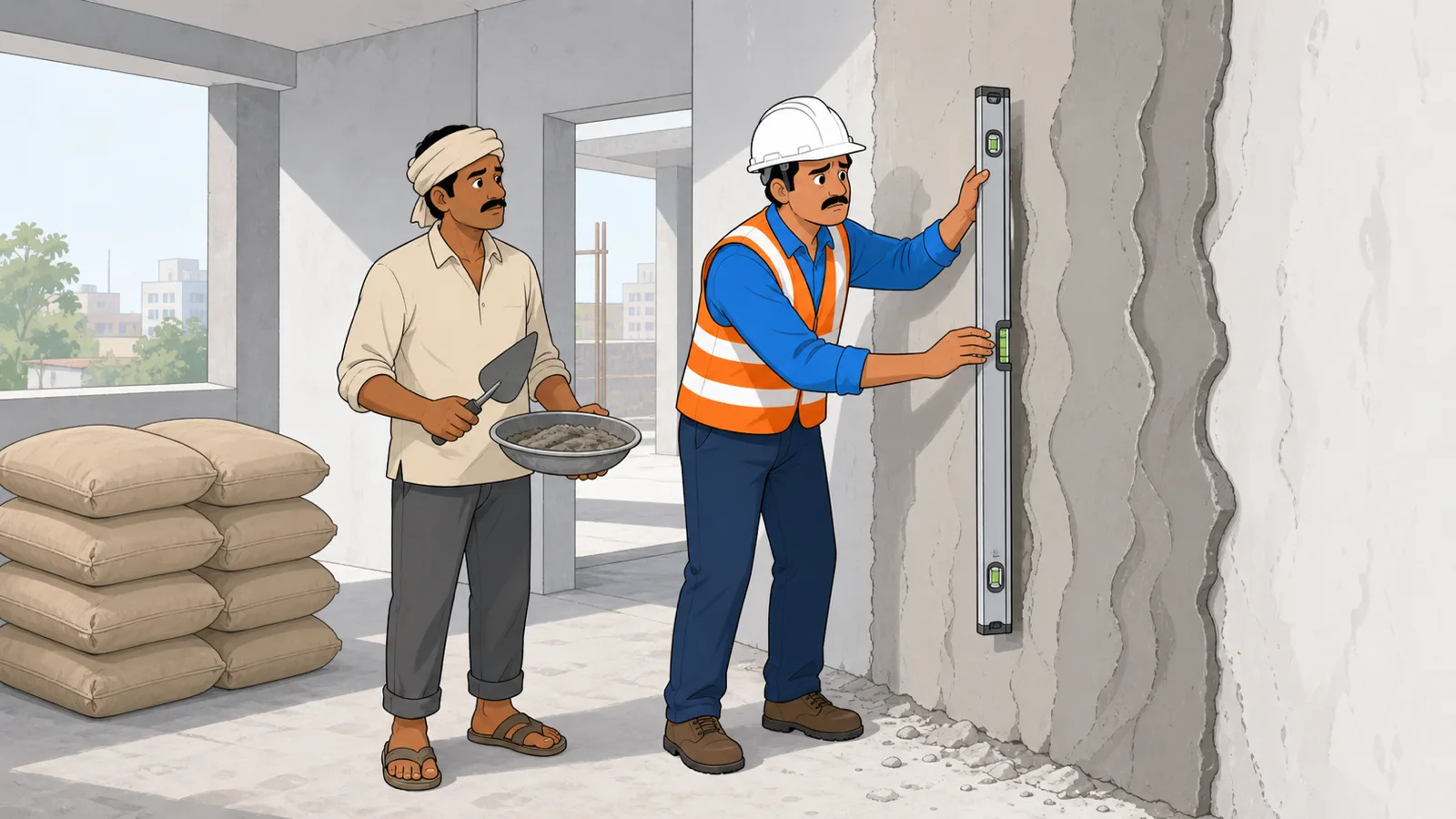
No project loses money in one dramatic moment. It loses Rs. 15,000 in plaster nobody measured, Rs. 16,000 in a slab that ran thick, Rs. 35,000 in a trench dug for the machine's convenience — errors that are invisible individually and lethal in total. None of them appear in any bill as "error." They appear as "consumption zyada ho gaya." This lesson prices the six most common leaks with worked numbers, and shows who actually eats each one on an Indian site. All rates are indicative mid-2026 market figures — always use your city's current quotations.
Error 1: the plaster that grew 10 mm
A G+1 house has about 320 m2 (roughly 3,440 sqft) of internal plaster per floor, specified 12 mm thick in 1:4 cement mortar. The brickwork went up without plumb discipline, no thiyya (level dots) were placed before plastering, and the masons buried the waviness in mortar: actual average thickness 22 mm.
Here is the Indian-site dynamic that makes this error so common: on a typical labour-rate contract, the thekedar bills plaster per sqft of area and the owner supplies cement and sand. Thickness does not appear anywhere in the thekedar's bill — 12 mm or 22 mm, he is paid the same Rs. 22–28 per sqft labour. The extra material is entirely the owner's loss, and nobody on site except the owner's QS has any incentive to control it.
Costing the extra 10 mm (one floor):
| Step | Calculation | Result |
|---|---|---|
| Extra wet mortar | 320 m2 x 0.010 m | 3.20 m3 |
| Dry material (x 1.33 for voids) | 3.20 x 1.33 | 4.26 m3 |
| Cement (1 part of 5 in 1:4) | 4.26 / 5 = 0.851 m3; / 0.0347 m3 per bag | ~25 bags |
| Sand (4 parts of 5) | 4.26 x 4/5 | 3.41 m3 ≈ 120 cft |
| Cement cost | 25 x Rs. 400 | Rs. 10,000 |
| Sand cost | 120 cft x Rs. 48 | Rs. 5,760 |
| Material loss per floor | ~Rs. 15,800 |
Two floors: ~Rs. 31,600 — plus about 6.4 tonnes of unplanned dead load per floor hanging on a structure that was never designed for it. Regional note: where river sand is scarce and dearer (much of the South and West now runs on M-sand; parts of the North still truck river sand under royalty), the sand line alone can double.
Prevention costs almost nothing: plumb-check the brickwork wall by wall before it dries, place thiyya dots at 1–1.5 m spacing before plastering starts, and record dot thickness in the DPR with the thekedar's signature. That signed record is also your dispute weapon: when the cement store empties faster than the sqft billed can explain, the dots — not tempers — decide whether the walls or the store register is lying.
Error 2: the slab that gained 15 mm
Same house, 200 m2 slab designed 125 mm thick. Without level dots on the reinforcement or screed rails, the pour averages 140 mm. Extra concrete: 200 x 0.015 = 3.0 m3 per slab; at Rs. 5,200 per m3 of M25 RMC that is Rs. 15,600 per slab — Rs. 62,400 over four slabs of a G+3. You met this leak in Lesson 2's pour-card reconciliation; here is its yearly total. The client pays drawing quantities, so on a lump-sum or item-rate job this is pure contractor loss; on an owner-managed site it is pure owner loss. Either way it is someone's real money, and it also silently adds roughly 7.5 tonnes per slab to the structure's dead load.
Prevention: level dots welded or tied at 2 m grid, a depth gauge (a marked rod costs nothing) used during the pour, and the pour card's theoretical-vs-delivered line reviewed the same evening.
Error 3: the trench dug for the machine's convenience
Lesson 1 priced over-wide excavation. Over-deep excavation is worse, because the fix is not soil. If a JCB overshoots the founding level by 150 mm across 12 footings of 2.0 m x 2.0 m, the over-dug volume is 12 x 4.0 x 0.15 = 7.2 m3 — and it cannot be made up with loose backfill: soil dumped under a footing settles, and the footing settles with it. Standard practice is to make up the level in lean concrete (PCC 1:4:8) or as the designer directs. At an indicative Rs. 4,800 per m3, that is Rs. 34,560 of concrete bought because nobody stood over the machine with a level pipe for ten minutes. On black-cotton and expansive-soil belts the stakes are higher still — founding depth there is a design decision, and casual over-digging can reopen the whole question. Whose account? If the excavation thekedar had the drawing and the level, his; if nobody gave him a level reference, yours. The DPR entry made that day decides which.
Error 4: honeycomb, missing cover and the repair bill
Congested beam-column junctions poured with 10–20 mm slump concrete, no standby vibrator, cover blocks "finished ho gaye" mid-pour: the shutters come off showing honeycomb and steel shining through soffits. A typical patch — chip to sound concrete, bonding agent, polymer-modified mortar or micro-concrete — runs an indicative Rs. 2,000–5,000 per location including material and a mason-helper day; call it Rs. 30,000 for ten locations on a careless structure. The direct cost is the small part: every honeycomb triggers an NCR, a client inspection, sometimes an engineer-mandated core test (Rs. 2,000–4,000 per core, Lesson 3), and a client who now doubts every bill you send. Exposed steel on chajja and balcony edges is also the defect that surfaces in year three — inside a RERA developer's defect-liability window, when the repair happens at parapet height with the flat occupied, at many times the cost.
Error 5: water in the truck — the lakh-scale error
Every error above costs thousands. Adding water to RMC to make pumping easier is the one that costs lakhs, because it does not waste concrete — it ruins it. A 45 m3 slab pour of M25 is about Rs. 2.34 lakh of concrete; add two buckets per truck and the cube results arrive low in 28 days, after the columns of the next floor are already standing on the slab. Now the options are core tests, consultant reviews, strengthening, or demolition — every one of them costlier than the Rs. 37,800 truck you should have rejected at the gate (and which, per Lesson 3, is the plant's account when slump is out of IS 4926 tolerance). The QS's protection here is procedural, and it is one line: no water at site, slump per truck on the pour card, reject out-of-tolerance loads.
Error 6: curing skipped to save a helper's hazri
Curing is the cheapest line in the entire budget and the most skipped. One dedicated helper at an indicative naka rate of Rs. 500–600 per day for 14 days of ponding and wall-wetting costs Rs. 7,000–8,400 per pour cycle. Skipping it invites plastic-shrinkage cracks in slabs, chalky low-strength plaster that hollow-sounds in a year, and concrete that never reaches the strength its cubes promise — lab-cured cubes pass while the site-dried slab quietly does not, and studies consistently show poorly cured concrete giving up a substantial share of its potential strength. There is no cheaper insurance on a construction site than a water pipe and a hazri.
The scoreboard
| Error | Worked cost (this lesson's example) | Who usually eats it |
|---|---|---|
| Plaster +10 mm, two floors | Rs. 31,600 material | Owner (labour-rate + owner-supplied material) |
| Slab +15 mm, four slabs | Rs. 62,400 concrete | Contractor on lump-sum; owner on managed sites |
| Over-excavation 150 mm deep | Rs. 34,560 PCC make-up | Whoever lacked or ignored the level reference |
| Honeycomb, 10 locations | Rs. 30,000 + NCRs + doubt | Executing contractor |
| Rejected 45 m3 pour (worst case) | Rs. 2,34,000 + demolition + delay | Fought over — records decide |
How this protects your bill
Every one of these leaks becomes a dispute the moment two parties disagree about whose account it is — and every dispute resolves on whatever was written down on the day. Thickness dots signed in the DPR, theoretical-vs-delivered on the pour card, the level reference issued in writing to the excavation thekedar, slump per truck: these records are what let an owner refuse a padded material demand, and what let an honest contractor prove the extra consumption was the design's, not his. Measure the leak the day it happens, in rupees, on paper. "Consumption zyada ho gaya" is not a line item; it is a confession that nobody was measuring.
Common mistakes
- Judging plaster and slab thickness by eye and arguing about it after the material is consumed.
- Letting material control end at the store register — issue quantities prove nothing without measured work to divide them by.
- Treating each small leak as "chalta hai" because no single one justifies a fight — total them monthly instead.
- Blaming the mason for what the brickwork's plumb caused — fix the cause upstream, not the symptom downstream.
- Keeping no daily record, then trying to reconstruct whose account an error is at final bill.
What comes next
Some deviations are not errors at all — every trade has permitted tolerances, and work inside them is neither rework nor deduction. The next lesson draws those lines: what IS 456 permits, what happens beyond it, and who pays for rework when the tape says "out."
Key takeaways
- Budgets leak in millimetres: 10 mm of extra plaster over two floors of a G+1 is roughly Rs. 31,600 of the owner's cement and sand.
- On labour-rate contracts with owner-supplied material, the thekedar has zero incentive to control thickness — only measured dots and DPR records do.
- Over-deep excavation is made up in lean concrete, never loose soil: 150 mm across 12 footings is about Rs. 34,560.
- Slab thickness control (level dots, depth gauge, pour-card reconciliation) saves thousands per pour and tonnes of dead load.
- Adding water to RMC converts a Rs. 37,800 truck rejection into a potential lakh-scale structural investigation.
- Total the small leaks monthly in rupees — individually 'chalta hai' items are collectively a lakhs-scale overrun.
Verify on site
- Plumb-check brickwork before it sets and place thiyya dots before any plastering starts; record dot thickness in the DPR.
- Fix level dots or screed rails before every slab pour and verify thickness with a depth gauge during casting.
- Issue the excavation level reference in writing and check founding levels before the machine leaves.
- Keep a standby vibrator and count cover blocks against the plan before signing the pour card.
- Refuse water addition to RMC at site; record slump per truck and reject out-of-tolerance loads.
- Assign and pay for a dedicated curing helper; log curing start and duration on the pour card.
- Reconcile material issued vs measured work monthly, not at project end.
Check your understanding
4 questions. Answering them marks this lesson complete — results stay on your device.
Want the free certificate?
The whole course is free and open — no signup needed to learn. Enter your details only if you want us to track your progress on this device and issue a named certificate after the final assessment.