Capstone BOQ and Budget
Lesson 58 of 60 · 8 min read
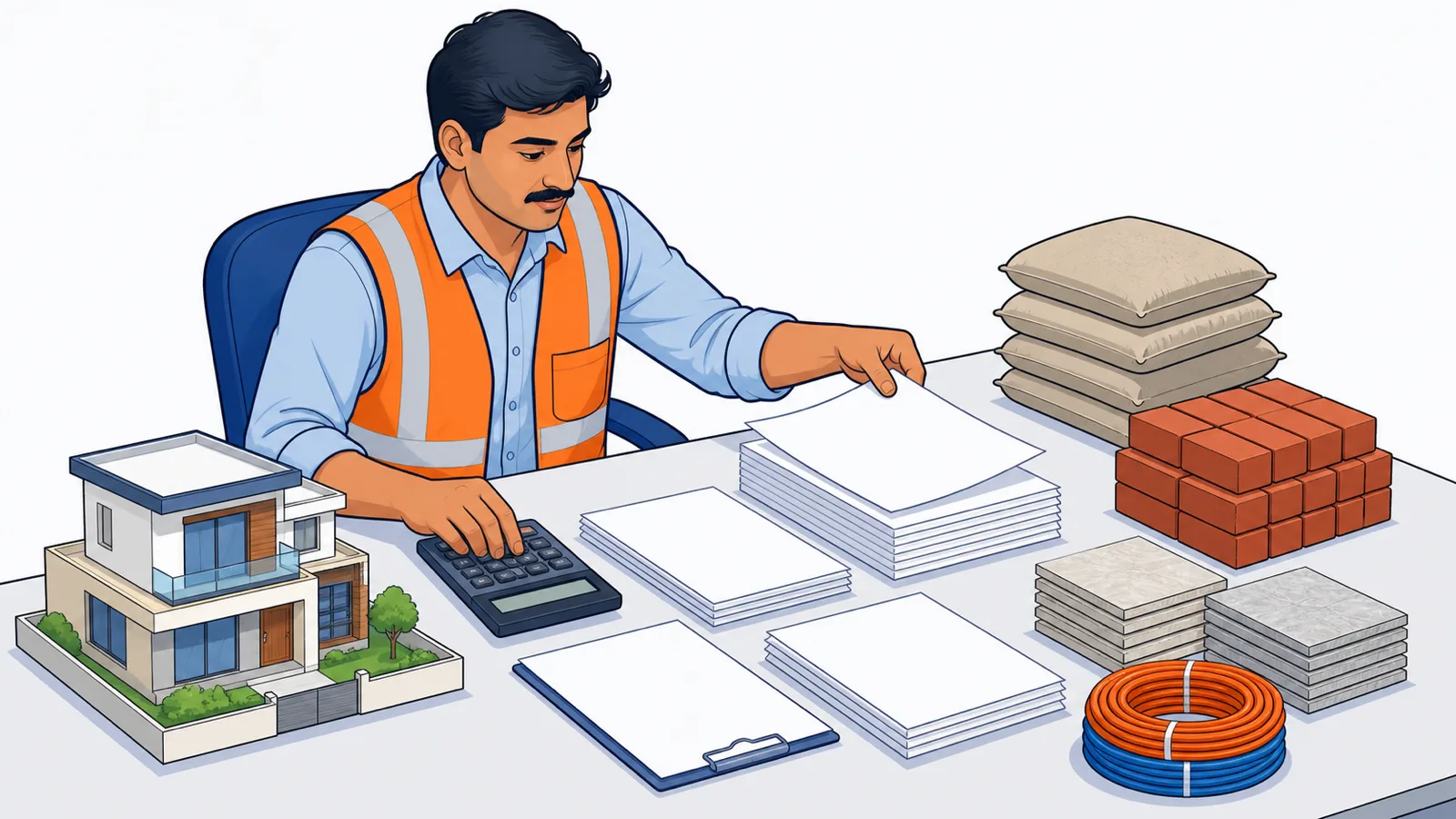
A takeoff without rates is a list; with rates it becomes the document every payment, order and argument on the project will reference. In this lesson the Lesson 2 quantities are priced into a condensed BOQ, checked against a per-sqft benchmark, and re-cut into the stage-wise budget the owner will actually fund.
Two ground rules from Module 4 carry over. First, each rate is an item rate: material + labour + machinery + contractor overheads and profit, for the item as described — built up by rate analysis, not guessed. Second, rates here are indicative mid-2026 figures for a tier-2 city (cement approx ₹400/bag against a market band of roughly ₹340-460; Fe 500 TMT approx ₹62/kg basic, ex-GST). Replace every one of them with rates built from your own city's current quotations.
The condensed BOQ
A real BOQ for this house runs 80-200 lines. Condensing to 20 major items keeps the logic visible; the totals behave the same.
| # | Item | Qty | Unit | Rate (₹) | Amount (₹) |
|---|---|---|---|---|---|
| 1 | Earthwork excavation for foundations | 35.3 | cum | 220 | 7,766 |
| 2 | Plinth filling with compaction | 20.0 | cum | 400 | 8,000 |
| 3 | PCC 1:4:8, 100 mm | 2.35 | cum | 5,400 | 12,690 |
| 4 | RCC M20 all members (excl. steel, excl. formwork) | 43.5 | cum | 8,200 | 3,56,700 |
| 5 | TMT Fe 500 — supply, cut, bend, fix | 4,690 | kg | 78 | 3,65,820 |
| 6 | Formwork all members | 340 | sqm | 420 | 1,42,800 |
| 7 | Brickwork 230 mm, CM 1:6 | 36.4 | cum | 7,200 | 2,62,080 |
| 8 | Brickwork 115 mm, CM 1:4 (with RCC bands as needed) | 123.6 | sqm | 950 | 1,17,420 |
| 9 | Internal plaster 12 mm, CM 1:6 | 344 | sqm | 280 | 96,320 |
| 10 | Ceiling plaster 6 mm | 138 | sqm | 260 | 35,880 |
| 11 | External plaster 18 mm, double coat | 218 | sqm | 380 | 82,840 |
| 12 | Vitrified tile flooring 600x600 with bedding | 130 | sqm | 1,350 | 1,75,500 |
| 13 | Anti-skid flooring + ceramic dado (wet areas) | 40 | sqm | 1,300 | 52,000 |
| 14 | Internal painting: putty + primer + emulsion | 482 | sqm | 220 | 1,06,040 |
| 15 | Exterior painting | 218 | sqm | 210 | 45,780 |
| 16 | Doors and windows (main door, flush doors, UPVC) | 1 | LS | 3,40,000 | 3,40,000 |
| 17 | Terrace waterproofing with screed | 72 | sqm | 450 | 32,400 |
| 18 | Electrical: wiring, switches, DB, fixtures | 1 | LS | 3,10,000 | 3,10,000 |
| 19 | Plumbing and sanitary complete | 1 | LS | 2,80,000 | 2,80,000 |
| 20 | Staircase railing, misc. metal and sundries | 1 | LS | 90,000 | 90,000 |
| Total (contract value) | 29,20,036 |
Item 14's quantity is internal plaster 344 + ceiling 138 = 482 sqm (painting follows the plastered surface). Item 4's rate deserves a check against Module 4: materials for 1 cum of M20 at approx 8.06 bags x ₹400 plus sand and aggregate come to roughly ₹5,700-6,000; labour, machinery, water and 10-15 percent overheads and profit lift the item rate to about ₹8,200. If a contractor quotes ₹6,500 for this item, something (usually the steel or shuttering item) is loaded elsewhere.
Sanity check: the per-sqft benchmark
29,20,036 / 1,550 sqft = approx ₹1,884 per sqft.
Published mid-2026 benchmarks for standard-finish independent houses run about ₹1,800-2,800 per sqft depending on city and specification. Our figure sits at the economical end of that band — consistent with a tier-2 city, competitive item rates, and a scope that excludes land, boundary wall, gate, external development, approvals and consultant fees. The thumb rule cannot replace the BOQ; but a BOQ that lands far outside the thumb band is telling you to re-check something.
The naka cross-check: does the plaster rate survive contact with reality?
Item rates should reconcile with the daily rates a thekedar actually pays at the labour naka. Test item 9 (internal plaster, ₹280/sqm). A mason-plus-helper pair — indicative mid-2026 tier-2 naka rates around ₹800-1,000 for the mason and ₹500-650 for the helper, so say ₹1,500/day for the pair — finishes roughly 9-10 sqm of 12 mm plaster a day. Labour comes to about ₹160/sqm. Materials: 12 mm at dry-mortar factor 1.33 is 0.016 cum of CM 1:6 per sqm — roughly 0.07 bag of cement (₹28) plus sand (approx ₹25), say ₹55/sqm. Add scaffolding, curing, wastage and 15 percent overheads and profit, and you land at ₹260-290 — our ₹280 rate is honest. Run this one-minute check on any quoted rate: if a thekedar quotes ₹180/sqm for the same item, he is planning to skip something (usually the curing, sometimes the cement).
Many self-builders instead engage the thekedar labour-only (materials purchased by the owner on dealer credit — typically 30-45 day cycles, with cash discounts of ₹5-10 per cement bag for spot payment; on 570 bags that discount alone is worth ₹3,000-5,700). Labour-only civil rates run indicatively ₹280-400 per sqft of BUA in tier-2 cities — but that scope covers structure, masonry and plaster only, not the electrician, plumber, painter or tile mason. Comparing a labour-only ₹350/sqft against an item-rate ₹1,884/sqft as if they were alternatives is a category error; convert both to the same scope before deciding.
The stage-wise budget
The owner does not fund "items"; they fund stages. Re-cutting the same 20 items by construction stage (splitting items 4-6 between substructure and frame by the member quantities from Lesson 2) gives:
| Stage | Amount (₹) | Share | Running total (₹) |
|---|---|---|---|
| 1. Substructure (items 1-3 + below-plinth RCC/steel/formwork) | 2,16,048 | 7.4% | 2,16,048 |
| 2. Superstructure frame (balance of items 4-6) | 6,77,728 | 23.2% | 8,93,776 |
| 3. Masonry (7, 8) | 3,79,500 | 13.0% | 12,73,276 |
| 4. Plastering (9-11) | 2,15,040 | 7.4% | 14,88,316 |
| 5. Flooring and dado (12, 13) | 2,27,500 | 7.8% | 17,15,816 |
| 6. Doors and windows (16) | 3,40,000 | 11.6% | 20,55,816 |
| 7. Painting (14, 15) | 1,51,820 | 5.2% | 22,07,636 |
| 8. Waterproofing (17) | 32,400 | 1.1% | 22,40,036 |
| 9. Electrical + plumbing (18, 19) | 5,90,000 | 20.2% | 28,30,036 |
| 10. Railing and miscellaneous (20) | 90,000 | 3.1% | 29,20,036 |
The split-stage arithmetic is worth seeing once. Substructure RCC = footings 5.18 + below-plinth columns 1.28 + plinth beams 4.00 = 10.46 cum (₹85,772 at 8,200). Substructure steel = 415 + 195 (below-plinth share of columns) + 480 = 1,090 kg (₹85,020 at 78). Substructure formwork approx 40 sqm (₹16,800). With items 1-3 (₹28,456) the stage totals ₹2,16,048 — and the frame stage is simply items 4-6 minus these shares. When both stages are added back you recover items 4-6 exactly: 85,772 + 2,70,928 = 3,56,700, and so on. That reconciliation is the habit: every re-cut of the budget must sum back to the same total.
The classic pattern check also holds: frame + substructure = 30.6 percent — inside the usual 25-35 percent share published for RCC structure in residential budgets.
Contingency and the sanctioned budget
A fixed-scope, 10-month residential job commonly carries a 5 percent contingency for unforeseen items and minor variations (escalation provisions matter on longer or index-linked contracts; on a short fixed-rate job the rates already carry that risk).
| Line | Amount (₹) |
|---|---|
| Contract value (BOQ total) | 29,20,036 |
| Contingency at 5% | 1,46,000 |
| Sanctioned budget | 30,66,036 |
That is approx ₹1,978 per sqft all-in for the civil contract. The owner should also budget separately for approvals, water/electricity connections, compound wall and soft furnishing — outside our contract scope, and saying so in writing is part of the QS's job.
Common mistakes at BOQ stage
- Pricing steel inside the concrete item and then paying for it again as a separate item. Item descriptions must state inclusions and exclusions.
- Copying last year's rates. Cement and steel move; a rate analysis older than a quarter is a guess.
- No lump-sum breakups. Items 16, 18, 19 should each carry an annexed breakup; a bare LS is unbillable in stages and un-negotiable in disputes.
- A budget that does not sum back to the BOQ. If the stage view and item view disagree, one of them is wrong — find it before the owner does.
How this document protects your money: in an item-rate agreement, the item description is the contract. When the flooring thekedar later argues that "skirting was extra" or the electrician that "fixture installation was supply only", the argument is settled by whether the BOQ line says "including skirting up to 100 mm" and "wiring including fixing of fixtures" — five words written today versus a ₹40,000 argument next year. Every inclusion you can foresee belongs in the description, and every LS item needs its breakup annexed before signatures.
Next lesson, this BOQ becomes a live contract: three running-account bills, retention, GST and one variation.
Key takeaways
- The 20-item condensed BOQ for Anand Villa totals ₹29,20,036 — approx ₹1,884 per sqft, at the economical end of the mid-2026 ₹1,800-2,800 standard-finish band.
- Every rate is an item rate built by rate analysis (material + labour + machinery + OH&P); indicative rates must be replaced with current local quotations.
- The stage budget re-cuts the same items by construction sequence and must sum back to the identical total — reconciliation is the test of a correct budget.
- RCC structure takes 30.6 percent of the contract, inside the typical 25-35 percent residential share; MEP at 20.2 percent is the figure owners most often underestimate.
- Sanctioned budget = contract value + 5 percent contingency = ₹30,66,036; scope exclusions are stated in writing.
Verify on site
- Confirm every BOQ item description states its inclusions and exclusions (steel, formwork, scaffolding).
- Attach a breakup annexure to every lump-sum item before the contract is signed.
- Re-verify cement, steel, sand and aggregate quotations within 30 days of tendering.
- Cross-check the BOQ total against the per-sqft thumb band for your city and finish level.
- Sum the stage budget back to the BOQ total before presenting either to the owner.
- Record which items the contingency may be spent on, and who approves it.
Check your understanding
5 questions. Answering them marks this lesson complete — results stay on your device.
Want the free certificate?
The whole course is free and open — no signup needed to learn. Enter your details only if you want us to track your progress on this device and issue a named certificate after the final assessment.