Units of Measurement and IS 1200 Rules That Decide Your Bill
Lesson 3 of 60 · 9 min read
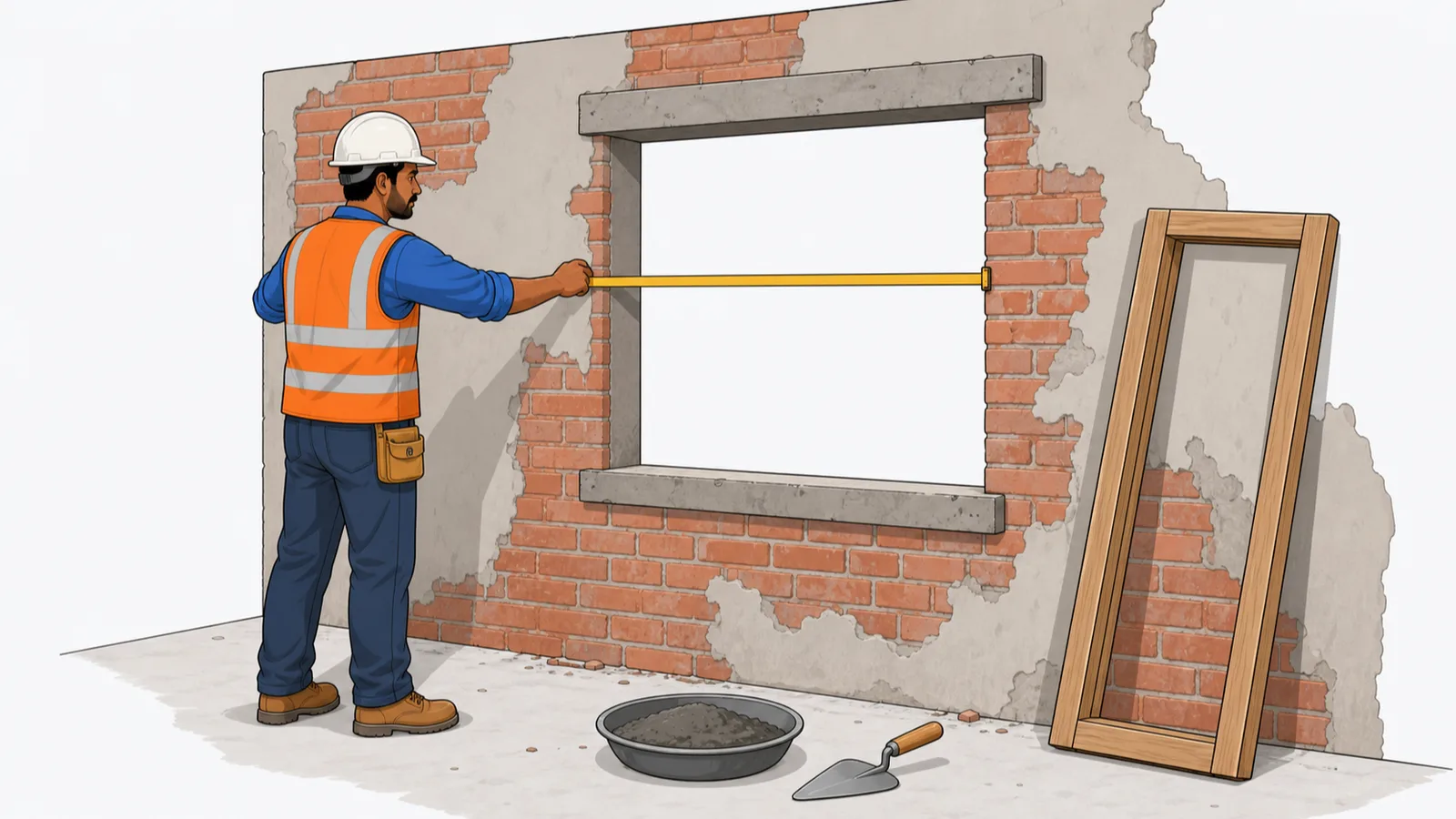
Give the same wall to two estimators and you can get two different bills - not because either cheated, but because one deducted a window from the brickwork and the other did not; one measured the half-brick partition in cubic metres and the other in square metres. Measurement without shared rules is just opinion. In India the shared rulebook is the IS 1200 series, "Method of Measurement of Building and Civil Engineering Works," and this lesson gives you the parts of it a working QS uses daily.
What IS 1200 is and why contracts lean on it
IS 1200 is not one code but a series of parts, each covering one trade: Part 1 earthwork, Part 2 concrete works, Part 3 brickwork, Part 4 stone masonry, Part 5 formwork, Part 12 plastering and pointing, Part 13 painting, and further parts for flooring, steelwork, and other trades. (BIS has been revising parts recently - for example earthwork and plastering carry new revisions - so always confirm which edition your contract references.)
Its power comes from contracts: government departments (CPWD, state PWDs, railways, MES) and most well-drafted private contracts state that work shall be measured per IS 1200. When measured quantity is disputed, the relevant part of IS 1200 is the referee. Two consequences for you:
- The contract can override the code. If your BOQ or contract states its own mode of measurement for an item, that governs. IS 1200 is the default, not an absolute. Read the contract's preamble and preliminary pages first.
- Knowing the rules is negotiating power. The party that can cite the measurement rule usually wins the argument without escalation.
The general rules: net as fixed, and how finely to measure
Across the series, work is measured net, as fixed in place - you measure the finished work the drawing calls for, not the material consumed making it. Wastage, laps, and spillage are the contractor's business, built into the rate (with specific exceptions the code states, such as measured reinforcement laps - Module 3 covers those).
The standard precision conventions are:
| Quantity | Worked to nearest | Notes |
|---|---|---|
| Dimensions | 0.01 m | Slab thickness finer, to 0.005 m |
| Areas | 0.01 sqm | |
| Volumes | 0.01 cum | |
| Weights | 0.001 tonne (1 kg) | Steel from standard unit weights |
Two practical implications. First, record dimensions in metres to two decimals in your measurement sheets (3.83, not 3.834 and not 3.8). Second, round at the end of an item's calculation, not at every intermediate step, or small biases accumulate across hundreds of entries.
One item, one unit
Every BOQ item is measured in exactly one unit, and the unit follows the shape of the work: things with significant volume in cum, sheet-like work in sqm, line-like work in rm (running metre), steel by weight, and countable things by number.
| Unit | Typical items |
|---|---|
| cum (cubic metre) | Earthwork excavation and filling; PCC; RCC; brick masonry one brick thick and above; stone masonry |
| sqm (square metre) | Plastering; painting; flooring and tiling; formwork/shuttering; half-brick (115 mm) walls; DPC; waterproofing |
| rm (running metre) | Skirting; pipes, conduits, cornices, beading; railings |
| kg / MT | Reinforcement steel; structural steel (from standard unit weights, not weighbridge) |
| nos (number) | Doors and windows (often also sqm); fixtures; fittings; soil test, chambers |
The traps sit at the boundaries:
- Brick walls: one brick (230 mm) thick and above are volume items in cum; half-brick (115 mm) partitions are measured in sqm with thickness stated in the description. Honeycomb brickwork and brick-on-edge are also sqm items. Billing a 115 wall in cum (or pricing it in the wrong unit) is one of the most common BOQ errors in small projects.
- Steel is computed, not weighed. Reinforcement is paid on lengths from the bar bending schedule converted to weight via standard unit weight (the d squared by 162 rule you will meet in Module 3) - not on truck weighbridge slips.
- A unit mismatch between description and unit column ("providing plaster... unit: cum") makes an item un-billable without a dispute. Check units line by line before a BOQ goes out.
Code units vs bazaar units: the conversion trap
IS 1200 and your BOQ speak SI; the Indian material market often does not, and money leaks in the gap:
- Sand and aggregate are sold per cft or - in western India - per brass (1 brass = 100 cft = 2.83 cum), elsewhere per tractor-trolley or per tonne. Remember 1 cum = 35.31 cft.
- Finishing trades quote per sqft while the BOQ is in sqm (1 sqm = 10.76 sqft).
- Steel is billed per kg, but a thekedar may quote bar bending per piece or per tonne.
Worked conversion: a dealer quotes sand at ₹5,500 per brass (indicative mid-2026, western India; sand prices swing sharply with local mining policy). Per cum that is 5,500 / 2.83 = ₹1,943 per cum. If your rate analysis carried ₹1,500 per cum from an old note, the estimate is silently about 29 percent low on sand before work begins. Convert every bazaar quotation to the BOQ unit in writing the day you receive it - and watch the volume basis too: a loosely heaped "brass" on a trolley is not a struck-measure brass, which is why careful sites measure the trolley box once and record its true volume.
Regional reality also changes the items themselves: river-sand scarcity has moved much of south and west India to M-sand at different rates; aggregate rates carry district-level royalty and lead differences; and walling shifts between clay brick, fly-ash brick, and AAC block by region. The measurement rules stay the same - but item descriptions and rates must match your district, not a textbook.
Deduction rules: the thresholds that move money
The rules people fight about are deductions for openings. The logic of the code is practical: small openings cost the contractor about as much labour as the material they save, so below a threshold nothing is deducted and nothing extra is paid for the fiddly work around the opening.
Brickwork (and stone masonry): no deduction for openings up to 0.1 sqm each; openings larger than 0.1 sqm are deducted at full opening volume. No deduction either for ends of beams and joists up to 0.1 sqm in section, bearings of slabs and chajjas within stated limits, small chases and holdfast blocks - and correspondingly no extra payment for forming them.
Plastering (both faces of a wall plastered with the same plaster):
| Opening size (each) | Rule |
|---|---|
| Up to 0.5 sqm | No deduction; no addition for jambs, sills, soffits |
| Above 0.5 up to 3 sqm | Deduct one face only; still no addition for jambs, sills, soffits |
| Above 3 sqm | Deduct both faces fully; measure and pay jambs, sills, soffits |
Where the two faces carry different finishes, or only one face is finished, the code has detailed tie-breakers based on which side the reveals are wider - for those cases, check the plastering part of IS 1200 rather than working from memory. Painting broadly follows the plastered surface it covers. RCC: no deduction from concrete volume for the volume of embedded reinforcement, nor for small openings and chamfers below the code's thresholds.
Worked example: one wall, every rule
A 230 mm thick brick wall, 10.0 m long, 3.0 m high, plastered 12 mm on both faces with the same plaster. Openings: one door D 1.2 x 2.1 m, one window W 1.5 x 1.2 m, one ventilator V 0.3 x 0.3 m.
Step 1 - classify each opening.
| Opening | Area | Brickwork (0.1 threshold) | Plaster (0.5 / 3 bands) |
|---|---|---|---|
| Door D | 2.52 sqm | Deduct | 0.5 to 3 band: deduct one face |
| Window W | 1.80 sqm | Deduct | 0.5 to 3 band: deduct one face |
| Ventilator V | 0.09 sqm | Below 0.1: no deduction | Below 0.5: no deduction |
Step 2 - brickwork (cum).
| Line | Calculation | Result |
|---|---|---|
| Gross volume | 10.0 x 3.0 x 0.23 | 6.90 cum |
| Deduct D | 2.52 x 0.23 | 0.58 cum |
| Deduct W | 1.80 x 0.23 | 0.41 cum |
| Net brickwork | 6.90 - 0.58 - 0.41 | 5.91 cum |
Step 3 - plaster (sqm), both faces.
| Line | Calculation | Result |
|---|---|---|
| Gross area | 10.0 x 3.0 x 2 faces | 60.00 sqm |
| Deduct D, one face | 2.52 | 2.52 sqm |
| Deduct W, one face | 1.80 | 1.80 sqm |
| Net plaster | 60.00 - 4.32 | 55.68 sqm |
Note what did not happen: the ventilator was ignored in both items, the door and window were deducted from one plaster face rather than two, and no jambs or sills were measured. An untrained biller deducting both faces for D and W would under-measure plaster by 4.32 sqm; one deducting nothing would over-measure by the same. The rules are the difference.
Common mistakes
- Deducting every opening from everything. The thresholds exist precisely so small openings are ignored - over-deduction is as wrong as under-deduction.
- Measuring half-brick walls in cum. They are sqm items with thickness in the description.
- Adding jambs and sills for mid-size openings. Jambs, sills, and soffits are paid only for openings above 3 sqm in the standard plaster rule.
- Applying IS 1200 when the contract says otherwise. The contract's stated mode of measurement overrides the default - always read the preamble.
- Rounding at every line. Keep dimensions at 0.01 m and round item totals at the end.
What comes next
Units and rules tell you how to measure; they do not tell you how accurate a given estimate needs to be. A thumb-rule figure for a first client meeting and a detailed BOQ for a contract are different instruments with different error bars - choosing the right one is the next lesson.
Key takeaways
- IS 1200 is the default Indian rulebook for measurement, but a contract's stated mode of measurement overrides it - read the preamble first.
- Work is measured net as fixed in place: dimensions to 0.01 m, areas to 0.01 sqm, volumes to 0.01 cum, steel to the kilogram from computed unit weights.
- Brick walls one brick thick and above are cum items; half-brick partitions, honeycomb work, and brick-on-edge are sqm items with thickness stated.
- Brickwork ignores openings up to 0.1 sqm each and deducts full volume above that.
- Plaster on both faces: no deduction up to 0.5 sqm, one face only from 0.5 to 3 sqm, both faces plus paid jambs and sills above 3 sqm.
- Over-deduction is as wrong as under-deduction - the thresholds exist because small openings cost as much labour as they save material.
Verify on site
- Read your contract's measurement preamble and note any item where it overrides IS 1200.
- Check every BOQ line for unit-description agreement (plaster in sqm, masonry 230 in cum, partition 115 in sqm).
- List all opening sizes from the door-window schedule and pre-classify each against the 0.1 / 0.5 / 3 sqm thresholds.
- Verify one recent brickwork measurement: were openings above 0.1 sqm deducted at area x wall thickness?
- Verify one plaster measurement: were 0.5 to 3 sqm openings deducted from one face only, with no jamb additions?
- Confirm steel is being billed from bar bending schedule lengths and standard unit weights, not weighbridge slips.
- Convert every dealer quotation in cft, brass, or sqft to the BOQ unit in writing before comparing rates, and verify the trolley or box volume once with a tape.
Check your understanding
5 questions. Answering them marks this lesson complete — results stay on your device.
Want the free certificate?
The whole course is free and open — no signup needed to learn. Enter your details only if you want us to track your progress on this device and issue a named certificate after the final assessment.