Material Reconciliation and Wastage Norms
Lesson 37 of 60 · 8 min read
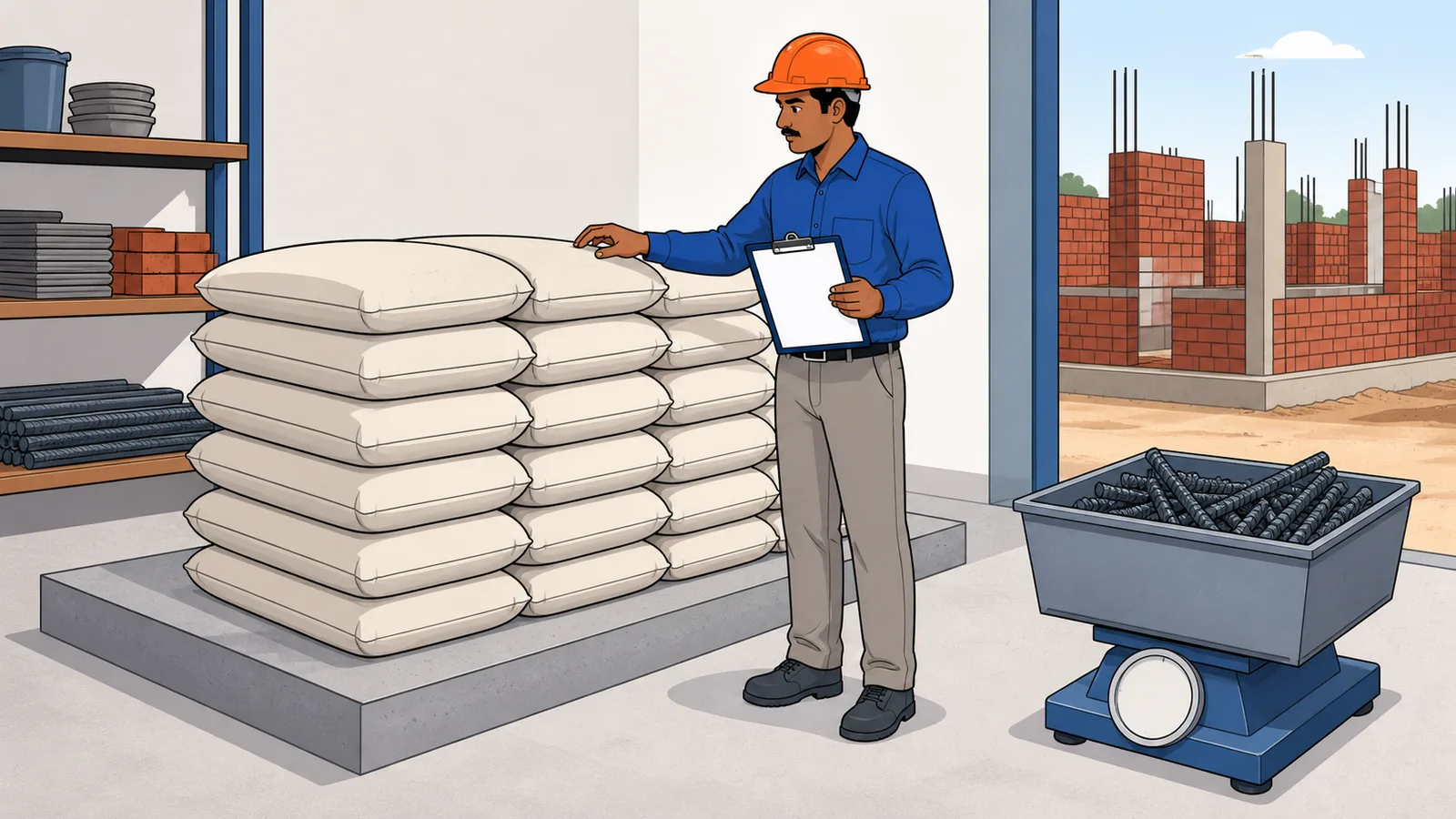
Cement disappears politely. Nobody announces it; the site simply consumes "a few bags more" every week — a torn bag here, a rich mix there, a wheelbarrow that went to the neighbouring plot. At Rs. 390 a bag, "a few bags a week" on a year-long project is upwards of Rs. 50,000, and by the time anyone notices, it is archaeology. Reconciliation is how you notice in the same month, while the leak is still cheap to fix.
Material reconciliation compares what was consumed against what should have been consumed for the work actually done, and judges the gap against an accepted wastage allowance. Three numbers, one verdict.
The method
Step 1 — actual consumption, from the stock register:
Consumed = Opening stock + Receipts (GRNs) - Closing stock (physical count)
Note what this equation cannot see: it counts a stolen bag as "consumed." That is the point — reconciliation flags the total gap; investigation then splits it into wastage, error, and theft.
Step 2 — theoretical consumption, from measured work: quantities of each item executed this period (from the measurement book) multiplied by the material coefficient for that item — cement per m3 of each concrete mix from the mix design, steel from the BBS, bricks per m3 of masonry, tiles per m2 laid.
Step 3 — the verdict:
Variance percent = (Consumed - Theoretical) / Theoretical x 100
Compare against the accepted planning range for that material. Inside the range: normal. Above it: investigate now, not at project end.
Accepted wastage planning ranges
An honest caveat first: no IS code prescribes universal wastage percentages. IS 1200 governs measurement, IS 4082 covers storage and stacking practice, and CPWD/DSR-style schedules embed wastage inside each item's rate analysis. The figures below are the ranges commonly used across Indian estimating practice and standard texts for planning and reconciliation — treat them as planning allowances, not entitlements, and expect your firm or contract to specify its own:
| Material | Accepted planning range | Poor-site upper end | Main causes |
|---|---|---|---|
| Cement | 2 - 3% | up to 5% | bag tearing, caking, dust loss, over-rich mixes |
| Steel (rebar) | 3 - 5% | — | cutting offcuts below reusable length, rolling margin effects |
| Bricks | 3 - 5% | up to 10% | transit breakage, cutting for closers, rough handling |
| Tiles | 5 - 10% | higher for diagonal layouts | edge and corner cutting; layout-dependent |
| Paint | 2 - 5% | — | tray and roller residue, over-application, spillage |
| Sand | 8 - 12% | — | handling, sieving loss, ground absorption |
| Aggregate | 5 - 8% | — | handling and transport spillage |
Reading the table correctly: buy tiles for a diagonal-layout bathroom at the top of the range; hold a straight-laid living room near the bottom. Steel wastage depends heavily on how well the BBS optimises cutting lengths against stock 12 m bars — a good BBS is a wastage-control document. And an allowance is a ceiling for planning, not a licence: a site running cement at 1.5 percent is performing, not under-reporting. (Practical reduction tactics are in our guide to reducing material wastage.)
Regional variation belongs in your norms too. Clay brick and AAC block waste differently — transit breakage dominates one, cutting on non-modular layouts the other — so a site switching wall systems needs a fresh norm, not the old number. M-sand and river sand sieve and bulk differently. After two months of your own reconciliation data, replace the table's ranges with your site's observed normals; the printed range is a starting grid, not a verdict.
The clause that turns reconciliation into money. When a thekedar works on labour rate and you supply material, reconciliation is your only defence against "material kam pad gaya" — and it becomes enforceable if the work order carries a consumption clause: allowable norms per item stated up front, excess consumption recoverable from running bills. Under such a clause, this month's 26 excess bags is not a finding, it is a Rs. 10,140 recovery entry in the thekedar's next payment — supported by issue slips his supervisor signed. This is commonly applied practice in labour-rate contracts; put the norms in the work order before work starts, and confirm the wording against your contract. Without the clause and the slips, the same 26 bags is an argument you lose politely every month.
Worked example: cement reconciliation for a slab month
This month the site cast 120 m3 of M25 (design mix, 340 kg cement per m3 from the approved mix design). Stock register: opening 120 bags, received 800 bags (three GRNs), physical closing count 62 bags.
Actual consumption:
- Consumed = 120 + 800 - 62 = 858 bags
Theoretical:
- Cement = 120 x 340 = 40,800 kg = 40,800 / 50 = 816 bags
- With 2 percent wastage allowance: 816 x 1.02 = 832.3 = 832 bags allowed
Verdict:
- Excess over allowance = 858 - 832 = 26 bags
- Total variance = (858 - 816) / 816 = 5.1 percent against a 2 percent allowance
- Money = 26 x 390 = Rs. 10,140 leaked this month (indicative mid-2026 cement rate)
Twenty-six bags is not a rounding error; it is roughly one small truck. The month-end conversation — checking mix proportions at the batching point, bag handling, issue-slip discipline, and whether any cement left the gate — happens now, with the trail warm, instead of at project end when Rs. 10,140 a month has quietly become a lakh.
Steel reconciliation: count the scrap too
Steel adds one wrinkle: visible scrap. The BBS for work executed this quarter totals 42.6 t. Issues from store: 44.8 t; steel still uncut in the yard: 0.4 t; scrap offcuts returned and weighed: 0.9 t.
- Consumed = 44.8 - 0.4 = 44.4 t
- Total wastage = 44.4 - 42.6 = 1.8 t = 1.8 / 42.6 = 4.2 percent — inside the 3 to 5 percent range, so no alarm.
- But split it: visible scrap 0.9 t (2.1 percent) and invisible loss 0.9 t (2.1 percent) — steel that is neither in the structure, nor in the yard, nor in the scrap bin.
The split is the insight. Invisible loss has only a few explanations: BBS or measurement error, rolling margin (bars genuinely lighter or heavier per metre than nominal), unrecorded issues — or theft. A site that weighs and records scrap can make this split; a site that lets offcuts vanish cannot, and hides theft inside "wastage" forever. Sell scrap against weighbridge slips and receipts, and credit it to the project (scrap value runs a meaningful fraction of fresh steel price — 0.9 t is real money). If invisible loss trends up across periods, act on it — our post on preventing material theft covers the usual routes out the gate, and the full statement format is in the material reconciliation guide.
Cadence and effort
Monthly for cement and steel (the money materials), and additionally at every major milestone — each slab, masonry complete, tiling complete. Per-material effort is under an hour if the stock register and measurement book are current — which is the honest reason most sites skip reconciliation: not the hour, but the discipline it depends on. That dependency runs straight back through Lessons 1 and 4: no GRNs, no issue slips, no reconciliation.
Common mistakes
- Reconciling at project end. A final-account reconciliation is a post-mortem; the money is gone. Monthly is the control.
- Skipping the physical count. Closing stock from the register instead of a count reconciles the register against itself and proves nothing.
- No allowance at all, or allowance as entitlement. Zero-wastage theory flags every period as a crisis and numbs everyone; treating 5 percent as a right invites drift to it.
- Not weighing scrap. Without a scrap figure, wastage and theft are indistinguishable — permanently.
- Theoretical from memory instead of measured work. The theory column must come from the measurement book and the BBS, or the whole exercise is fiction.
Where this goes next
Reconciliation produces the most persuasive numbers on the site — "26 bags over, Rs. 10,140" survives any argument. The final lesson packages these numbers, with commitments and forecasts, into the weekly cost report an owner will actually read.
Key takeaways
- Reconciliation = (Opening + Receipts - Closing physical count) compared against theoretical consumption from measured work, judged against a wastage allowance.
- No IS code prescribes universal wastage percentages — the accepted planning ranges are cement 2-3%, steel 3-5%, bricks 3-5%, tiles 5-10%, paint 2-5%, sand 8-12%, aggregate 5-8%, with poor sites running higher.
- In the worked example, 858 bags consumed against 832 allowed (816 theoretical + 2%) means 26 excess bags — Rs. 10,140 caught in one month instead of a lakh at project end.
- For steel, weigh and record scrap so wastage splits into visible offcuts and invisible loss — invisible loss is where BBS errors, rolling margin, and theft hide.
- An allowance is a planning ceiling, not an entitlement; reconcile monthly and at milestones, while the trail is warm.
- Reconciliation is only as good as its inputs: GRNs, issue slips, a live stock register, and a current measurement book.
Verify on site
- Do a physical count of cement stock today and compare against the stock register balance.
- Confirm every cement issue this week has an issue slip naming the work item.
- Verify a scrap steel area exists and offcuts are being returned, weighed, and recorded.
- Pull the mix design and check cement batching at the mixer against it (bags per batch).
- Run the consumption equation for last month and compare the variance to the planning range.
- Check scrap sales, if any, are against weighbridge slips and credited to the project.
Check your understanding
5 questions. Answering them marks this lesson complete — results stay on your device.
Want the free certificate?
The whole course is free and open — no signup needed to learn. Enter your details only if you want us to track your progress on this device and issue a named certificate after the final assessment.