The Measurement Book: Rules, Entries and Evidence
Lesson 40 of 60 · 7 min read
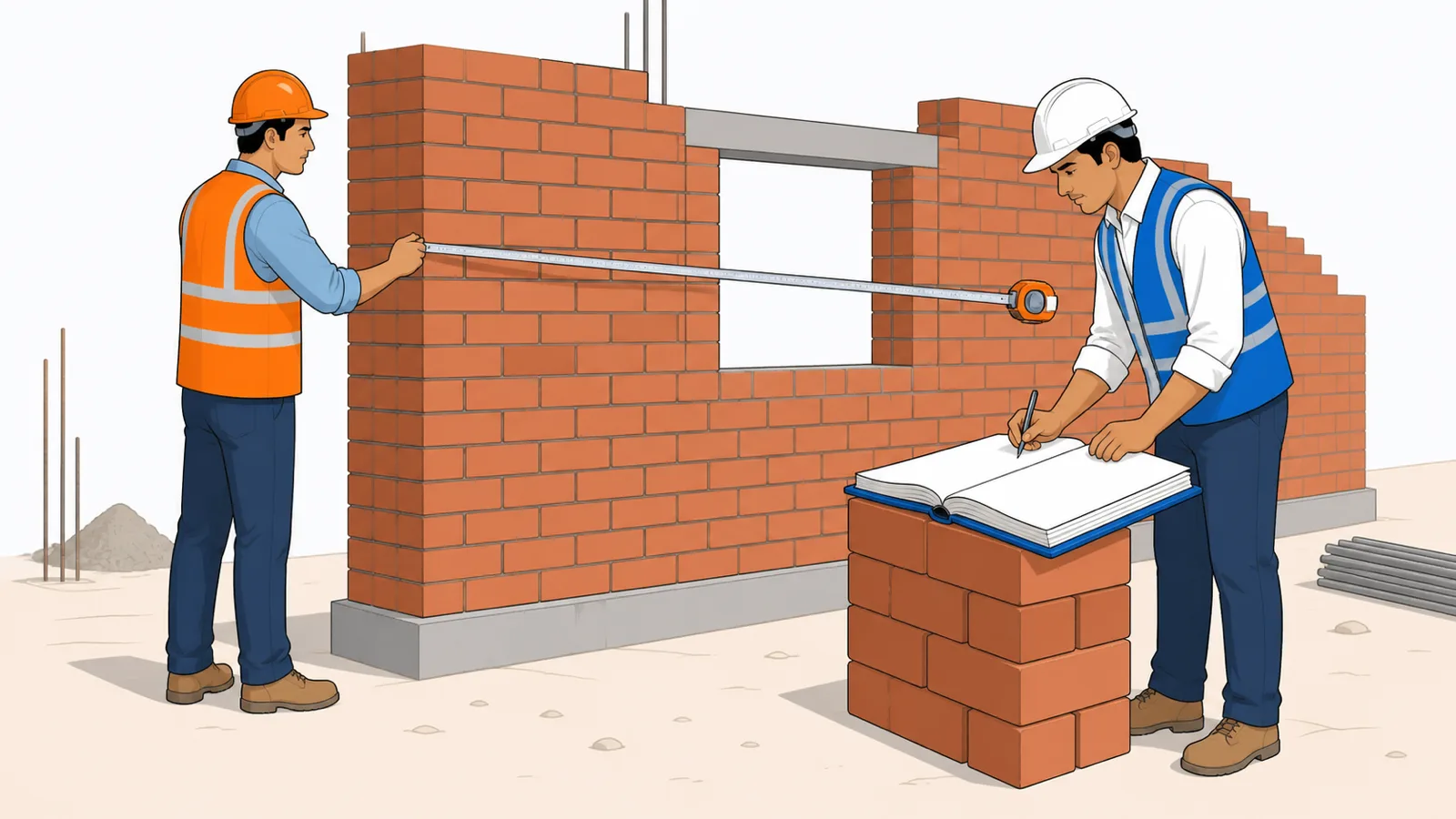
Ask any senior QS what document decides a payment dispute and the answer is the same: the measurement book. Not the WhatsApp photos, not the site diary, not anyone's memory — the MB. It is the primary record from which every quantity in every bill is derived, and in government work it is treated as an official document whose entries can be audited years later. Yet on many private sites the MB is either not maintained at all, or maintained so casually that it would collapse under the first serious challenge. This lesson gives you the rules, the entry format and a worked set of entries you can copy.
What the MB is — and what it is not
A measurement book is a bound, page-numbered register in which every measurable item of executed work is recorded with its dimensions, at the time of measurement, by a named person, and countersigned by the party being paid (or the party paying). CPWD practice — followed in spirit across Indian construction — treats the MB as the basis of all accounts of quantities: whatever is billed must trace back to an MB entry, and whatever is in the MB must trace back to work you can stand in front of.
The MB is not a diary, not a labour attendance register, and not a place for rough calculations. Rough field notes can live on a slip; the MB entry is the fair, final record.
The RERA era has raised the stakes on this discipline. Developers now carry statutory defect liability — under RERA a homebuyer can demand rectification of structural and workmanship defects reported within five years of possession — and consumer forums and arbitrators decide such fights on contemporaneous records. For the contractor, the same MB that supports the bill also proves what was built, to which drawing revision, and when. An owner or thekedar who "settles everything at the end from memory" is choosing the weaker side of every future dispute.
The recording rules that make an MB dispute-proof
These rules come from long-standing public-works practice. Follow them even on a private villa job — they cost nothing and they make your record unimpeachable:
- Bound book, machine-numbered pages. Never loose sheets. Missing pages destroy credibility.
- Ink or indelible entries. No pencil, no erasers, no correction fluid.
- Corrections by strike-through. Draw a single line through the wrong figure so it stays readable, write the correct figure beside it, and initial and date the correction.
- Every set of measurements starts with a header: date of measurement, name of work, agreement or work-order reference, location (for example "First floor, slab S2"), and who measured and who witnessed.
- Record at the time of measurement, on site, not reconstructed later in the office from memory or from the drawing.
- Signatures of both sides — the person recording and the contractor's representative — immediately below the last entry of the day, so nothing can be inserted afterwards.
- Cross-reference the drawing number and revision you measured against, and any test records (cube tests, level checks) that qualify the work as acceptable.
Where practice varies: some private clients accept measurement sheets (loose printed formats) signed jointly instead of a bound MB. That can work, but only if sheets are serially numbered, dated, signed by both parties on every page and filed — a joint measurement sheet is the minimum acceptable substitute, and our downloadable template below follows that discipline.
The entry format: Particulars, Nos., L, B, D
The universal MB entry format is a five-column table: description of the item (with location), number of identical measurements, and the three dimensions. The content column multiplies them out. Deductions are entered the same way, marked clearly as deductions, following IS 1200 rules for the trade — IS 1200 prescribes deduction thresholds per part (small openings below the threshold are not deducted; check the relevant part for your item).
Worked example — first-floor entries for a small house, measured jointly on site:
Item 1: Brickwork in 230 mm walls in CM 1:6, first floor (drawing A-104 Rev 2):
| Particulars | Nos. | L (m) | B (m) | D (m) | Content (cum) |
|---|---|---|---|---|---|
| Long walls | 2 | 9.14 | 0.23 | 3.00 | 12.613 |
| Short walls | 2 | 6.40 | 0.23 | 3.00 | 8.832 |
| Deduct: door openings | 2 | 1.00 | 0.23 | 2.10 | (-) 0.966 |
| Deduct: window openings | 4 | 1.50 | 0.23 | 1.20 | (-) 1.656 |
| Net brickwork | 18.823 |
Check the arithmetic yourself: 2 x 9.14 x 0.23 x 3.00 = 12.613 cum; 2 x 6.40 x 0.23 x 3.00 = 8.832 cum; deductions 0.966 and 1.656 cum. Net = 12.613 + 8.832 - 0.966 - 1.656 = 18.823 cum. Every figure in the bill's abstract must reproduce exactly from these lines.
Item 2: RCC slab M20 (1:1.5:3), first-floor roof slab, 125 mm thick:
| Particulars | Nos. | L (m) | B (m) | D (m) | Content (cum) |
|---|---|---|---|---|---|
| Slab S1 | 1 | 14.63 | 9.75 | 0.125 | 17.830 |
14.63 x 9.75 = 142.64 sqm; x 0.125 = 17.83 cum. Note the cross-reference you would add beside it: "Cube test ref CT-11 dated 04-06, 7-day result awaited" — the measurement records quantity; acceptance is a separate, linked record.
From MB to abstract
Measurements are recorded item-wise as work proceeds; at billing time you prepare an abstract: item description, unit, total quantity brought forward from MB pages (with page references), rate from the agreement, and amount. The abstract is what enters the RA bill. The chain must be unbroken: bill quantity → abstract → MB page and line → physical work. An auditor — or an angry client — will walk that chain in reverse.
Evidence beyond the MB
The MB records quantity. Disputes also attack quality, timing and authorisation, so the strong QS keeps a thin evidence file linked to MB entries:
- Dated photos of work that will be hidden — reinforcement before pouring, waterproofing before screed, depth of foundations before backfill. Hidden work is the single biggest source of measurement disputes; measure and photograph it before it is covered, and get the joint signature that day.
- Test records: cube tests, compaction, pressure tests, with dates matching the MB.
- Written instructions for anything extra or changed (Lesson 5 covers this in detail).
- Level and line records for earthwork and depth-based items — initial levels jointly recorded before excavation starts are the only defensible basis for excavation quantities.
Common mistakes
- Measuring from drawings instead of on site. Drawings are the design; the MB records what was built. Where they differ (they will), the MB must reflect reality — with the difference flagged.
- Batch-recording at month end. Reconstructed measurements are guesswork wearing an ink pen. Record while the work is fresh and accessible.
- No deductions. Skipping opening deductions inflates quantity and will be caught at final account, with interest in bad blood.
- Unsigned entries. An MB entry without the other party's signature is your claim, not a joint record.
- Overwriting figures. One overwritten digit can taint the credibility of the whole book. Strike through, rewrite, initial.
What comes next
The MB converts work into quantities. The next lesson converts quantities into money: the RA bill — how a running bill is structured, how cumulative billing works, and a full worked bill from gross value down to net payable.
Key takeaways
- Every billed quantity must trace back to a signed, dated MB entry — the MB is the basis of all quantity accounts.
- Entries go in ink in a bound, page-numbered book; corrections are struck through, rewritten and initialed, never overwritten.
- The five-column format (Particulars, Nos., L, B, D, Content) with explicit deductions is universal — follow IS 1200 deduction thresholds for the trade.
- Measure and photograph hidden work (reinforcement, waterproofing, foundation depths) before it is covered, with joint signatures the same day.
- The abstract bridges MB to bill: quantity, unit, MB page reference, agreement rate, amount — an unbroken auditable chain.
Verify on site
- Verify the MB is bound and machine page-numbered, with no loose sheets.
- Check today's entries carry date, location, drawing revision and both signatures.
- Confirm all corrections are single-line strike-throughs with initials and date.
- Measure reinforcement and other hidden work jointly before covering, with dated photos.
- Record initial ground levels jointly before any excavation begins.
- Cross-check one abstract quantity back to its MB page before every bill submission.
Check your understanding
4 questions. Answering them marks this lesson complete — results stay on your device.
Want the free certificate?
The whole course is free and open — no signup needed to learn. Enter your details only if you want us to track your progress on this device and issue a named certificate after the final assessment.